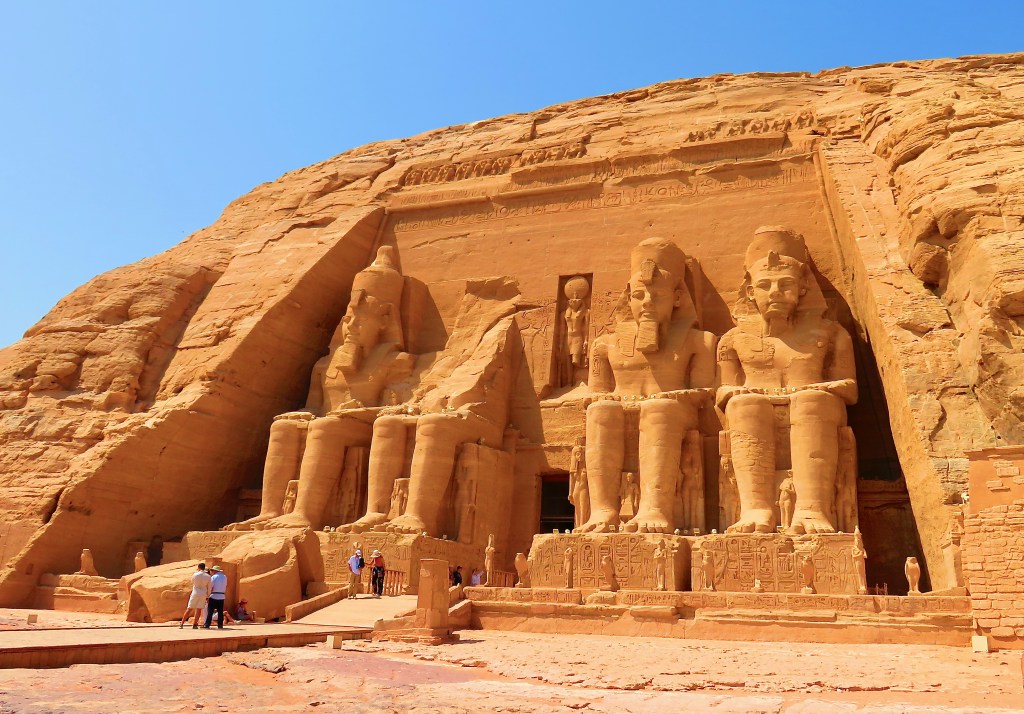
All great explorations have some challenging moments, and today’s excursion to Abu Simbel would prove to be quite the slog…but OH so worth it!
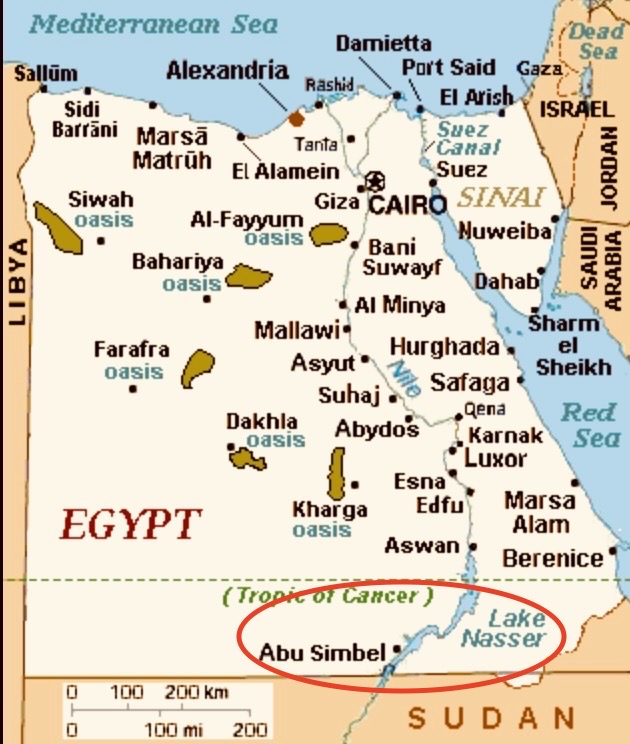
It’s too far to drive, so we fly from Aswan to Abu Simbel. We had a briefing in the lounge the evening before, at which Sameh (our cruise manager) explained we would have to split into two groups, one of which would leave at 5:15 am (!), the other at 7:30 am. A collective groan filled the room as each of us silently wished the early flight upon our neighbor, and as Sameh read the names assigned to the early flight, there was that childhood voice saying “don’t call my name…don’t call my name…” and a sigh of relief when he finished the list without me and Bobb on it.
Nonetheless, 7:30 off-the-ship is still early, and as the group of us stepped across the narrow bridge to the “dock,” not many words were spoken among us sleep-eyed explorers. Daypacks in hand, whispers ready to listen through, we climbed into our now familiar bus and headed for the Aswan airport.
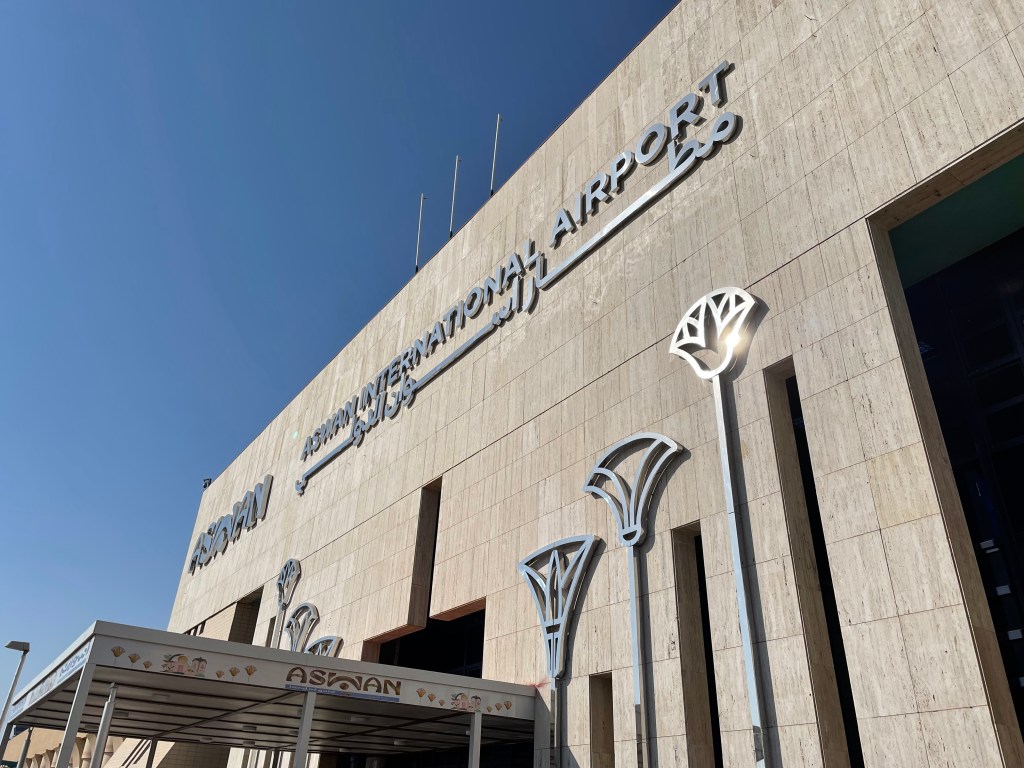
Aswan is a surprisingly modern city if Cairo is the local benchmark. A large university campus blankets a hillside. As we drive through Aswan, there is really nice housing…schools…offices …government buildings…and an overall sense of a thriving community. Ahmed, our guide, hopes to retire here some day. We arrive at the airport, and after the inexplicably complicated security screenings (don’t take this off – but take that off – but then do the opposite in the secondary screening, and physical pat-downs for everyone, women and men in separate lines), we waited in a clean but rather nondescript terminal. A cappuccino helps to pass the time until we board.
It’s a short flight, and the anticipation of reaching Abu Simbel awakens us as we stare out the plane’s windows hoping to catch a glimpse from above. And we do…and it is astonishing.

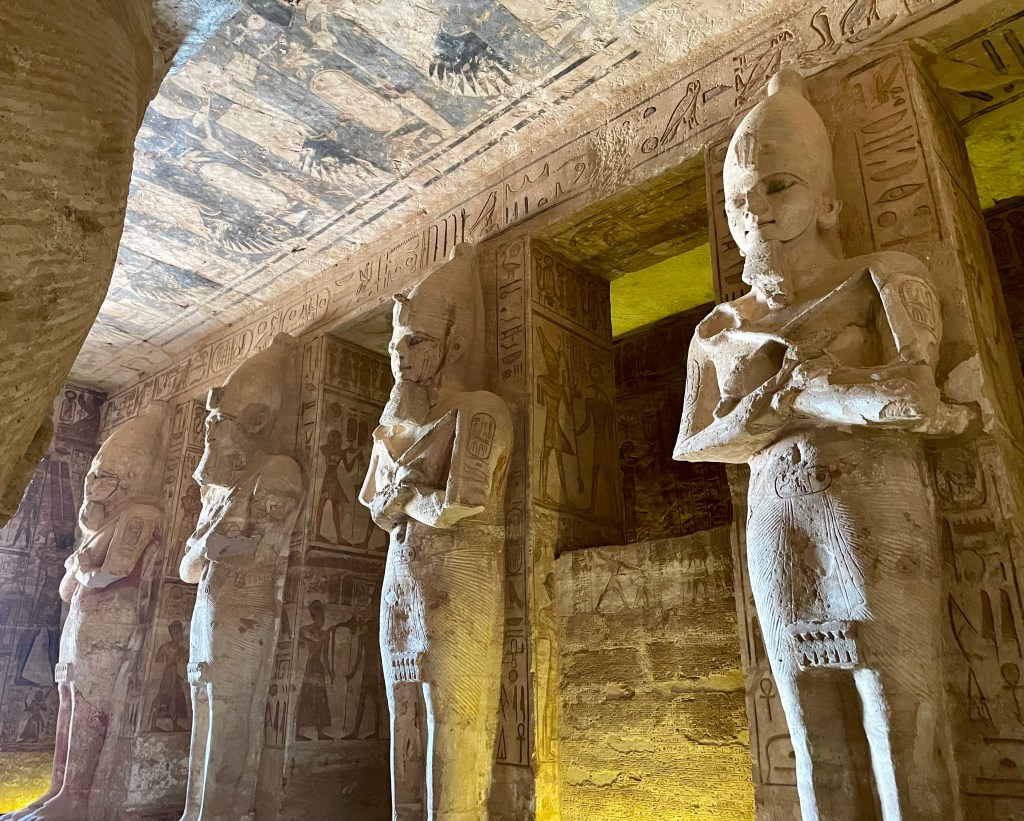
The Great Temple at Abu Simbel was built by Ramses II (1279-1231 BC) to project an image of power to the south of Egypt and to bring Egyptian culture to the Nubian people. We are very close to the Sudan border today; the southern Egyptian border was about the same even then. The temple is cut into the rock, its four 60-ft tall colossal statues of a seated Ramses achieving that projection of power with a resolved confidence that must have made any potential conquerors think twice. Several family members are standing at his feet, including his mother Tuy, his “first wife” Nefertari, two sons and six daughters (he is said to have fathered over 100 children with his multiple wives).

The temple faces Lake Nasser, created by the Aswan High Dam, so when visiting this mystical place you approach from behind it…a barren, dusty, pebble-strewn mound that portends of something amazing. That you can’t see it only adds to the drama of its later reveal as you approach the lake’s edge. The majesty of this enormous lake (6th largest in world) is almost a musical backdrop, an entr’act of a sort, when rounding the bend and the temple comes into view.
The crescendo plays and the cymbals ring out…
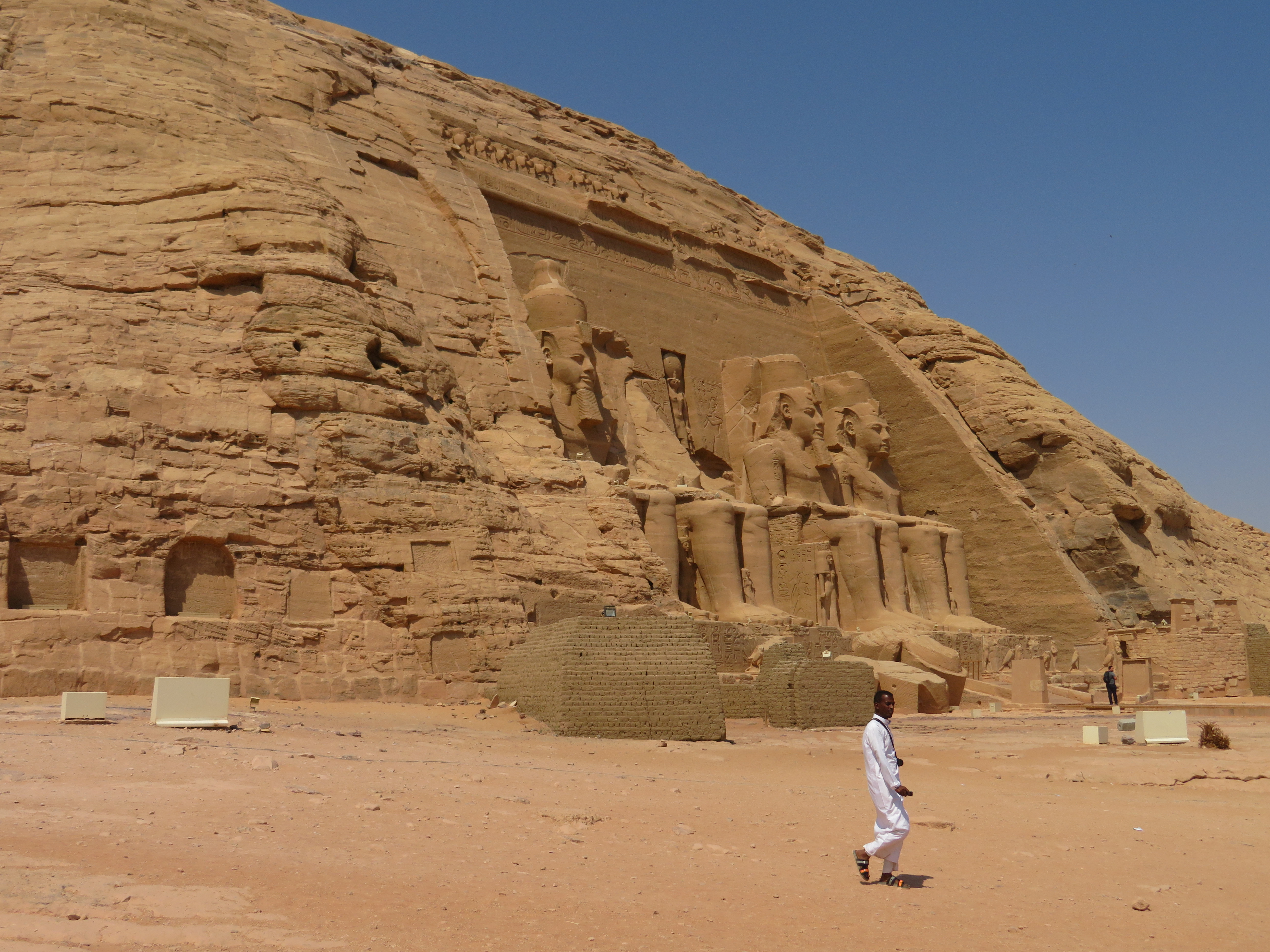

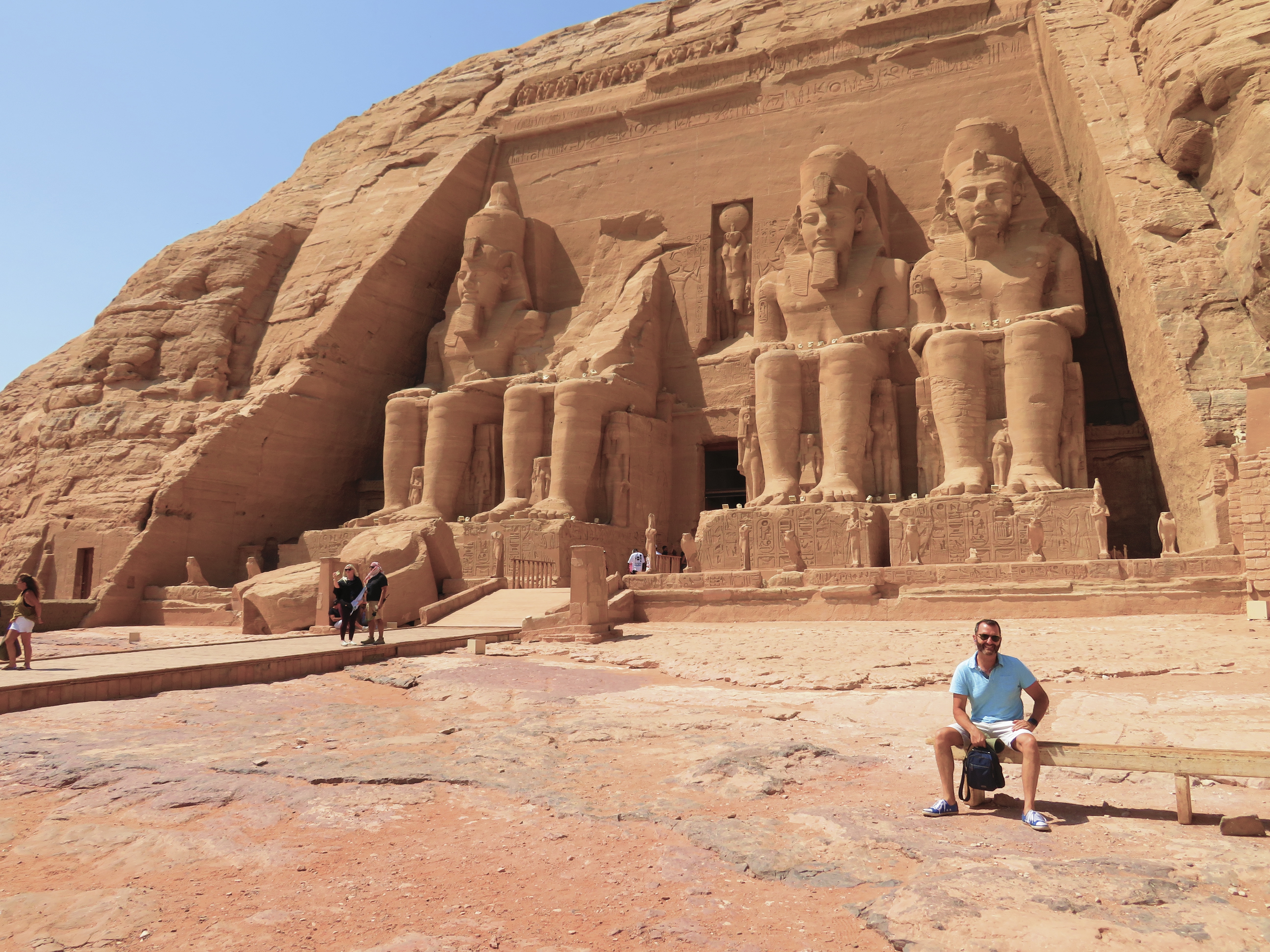


It is just WOW. It takes your breath away for a bit and forces you to stop in your tracks. Even 3,300 years later, it still has its intended effect – it is intimidating and powerful, not just in its command of the hillside and southerly stare into your very soul, but also of the man with the power and resources to construct such a place. His laborers toiled for 20 years…
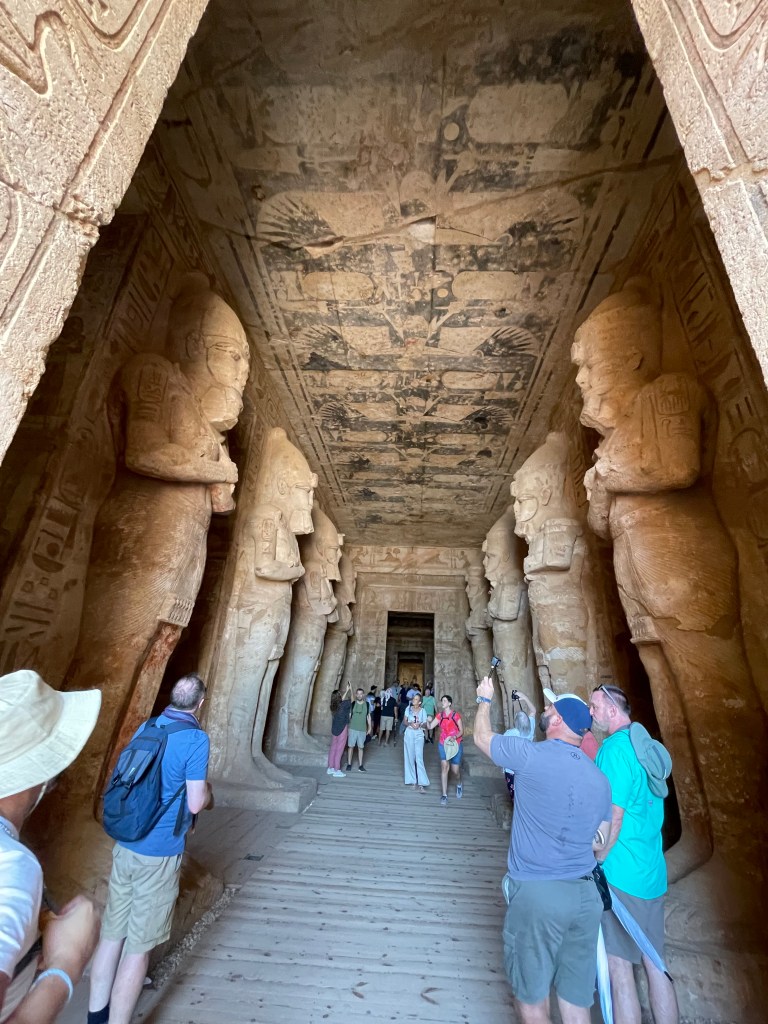
Ahmed is quiet for the first moments, letting us take it all in. He chats for a bit about Ramses II, orienting us to the figures on the Great Temple, and what we will find inside – many more side chambers than most temples, Ramses II deified as one with Osiris, and many depictions of the battles he waged and won. As Ahmed is always reminding us, the ancient Egyptians were intentional about everything, and the orientation of the temple is no exception: the sun shines through to illuminate the sculptures on the back wall twice a year – the pharaoh’s birthday and his coronation day.
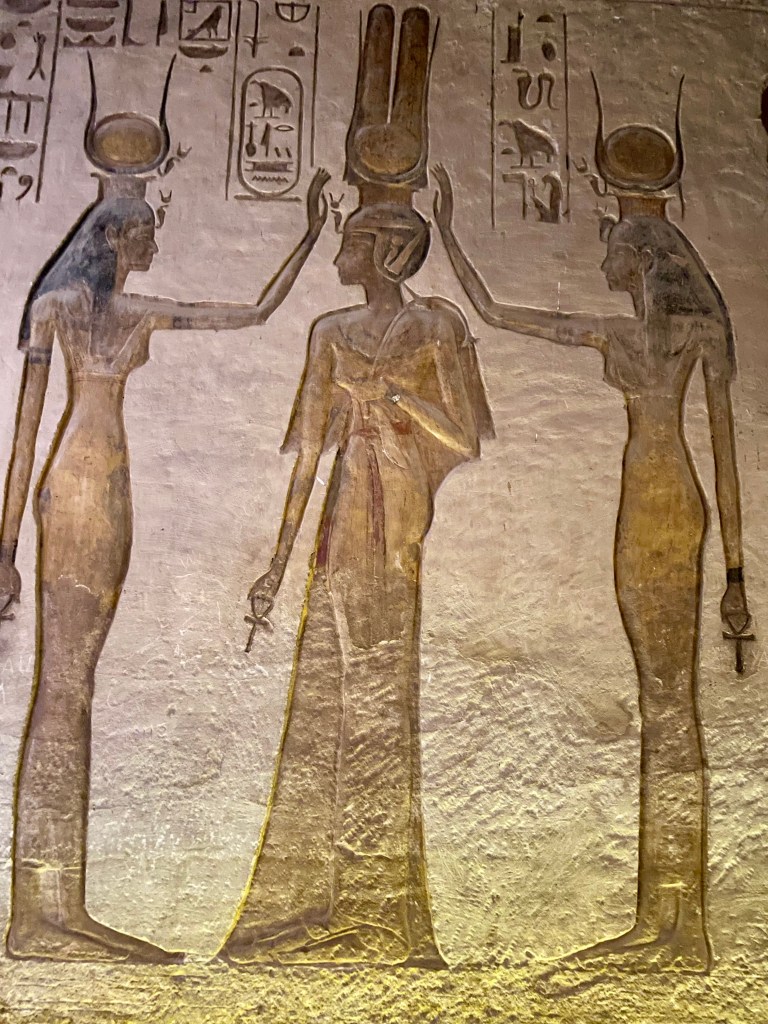



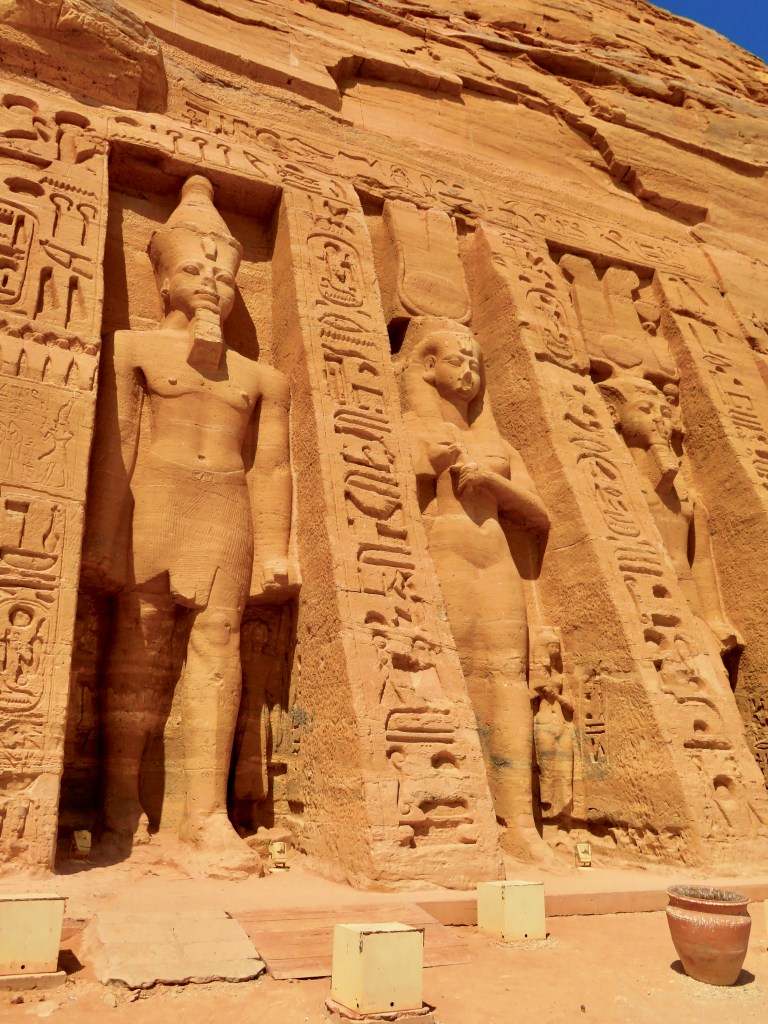
Ahmed turns our attention to the nearby “Small Temple” dedicated to Nefertari, which is not as grand in scale but just as stunning. It is only the 2nd time a temple was dedicated to a queen, and even more unusual is that the king and queen are depicted the same size (most often, the queen would come up to his knee). This tribute told of his profound love for Nefertari, making sure his people and all those who would come to this temple – us! – would know the depth of it.

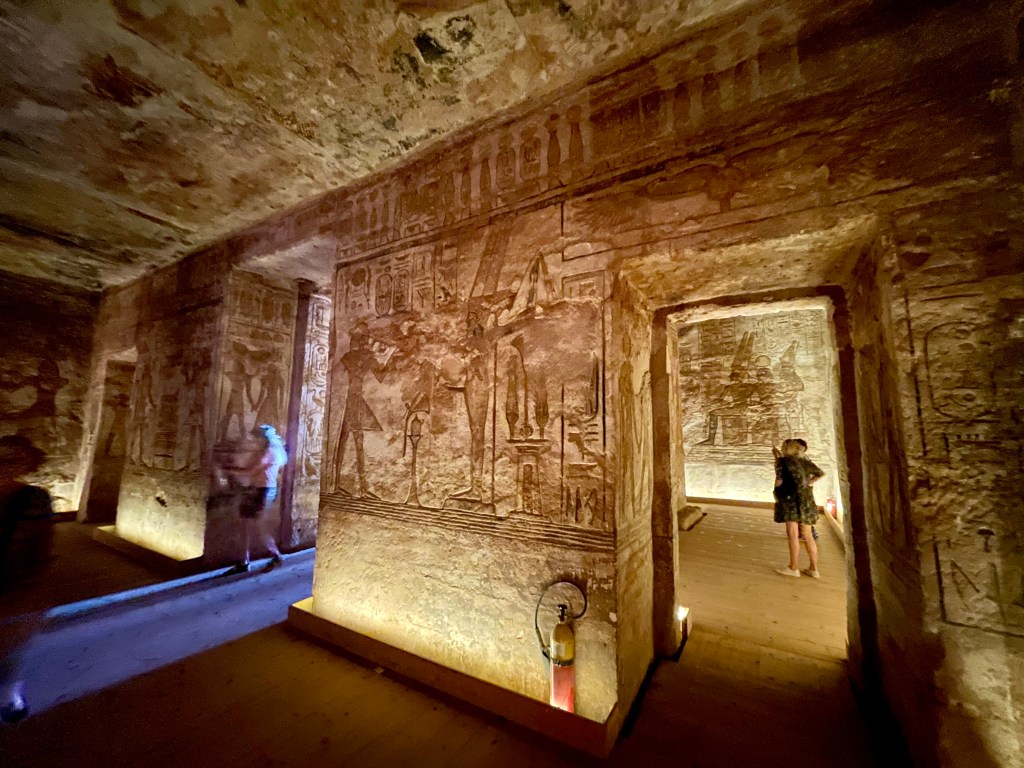
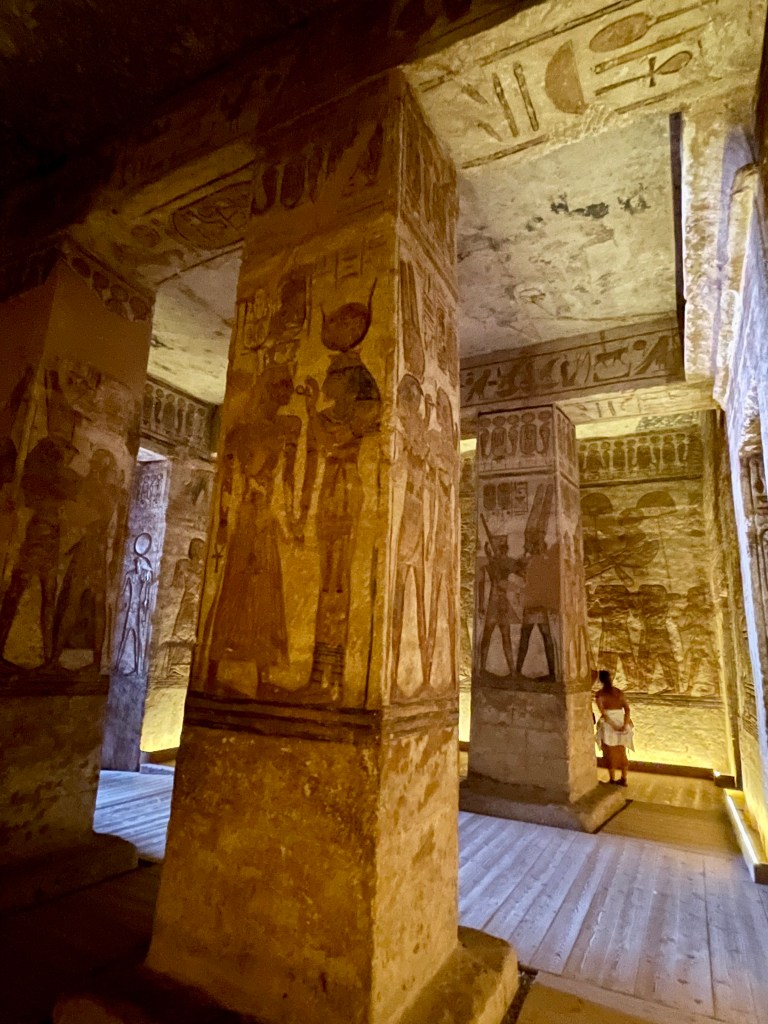
We are left to our own curiosity, exploring the dim halls and chambers, interpreting the endless characters telling us stories of offerings, devotion, worship…conquering. The walls echo with the voices long gone but still being heard today. All we have to do is listen.

Postscript
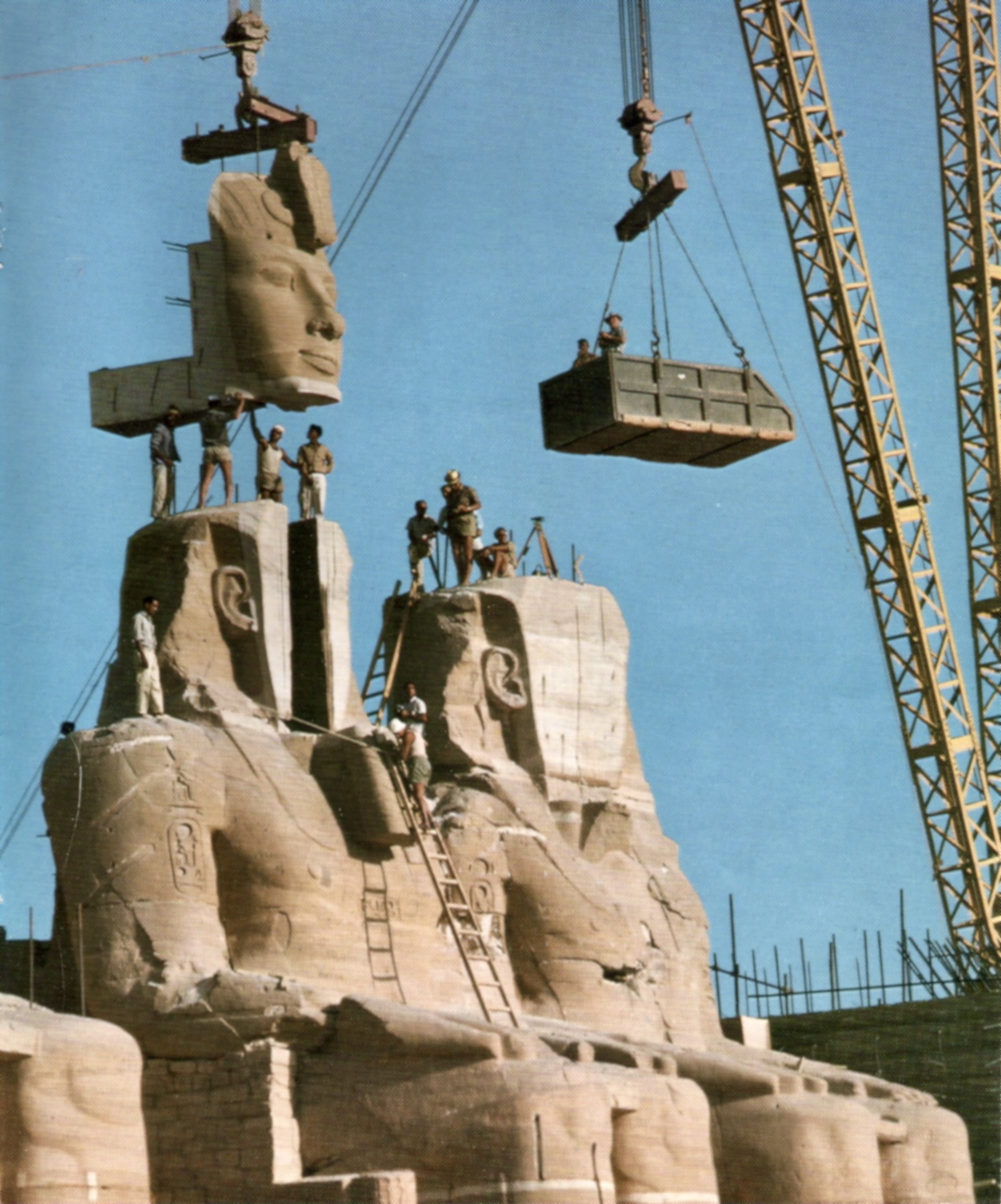
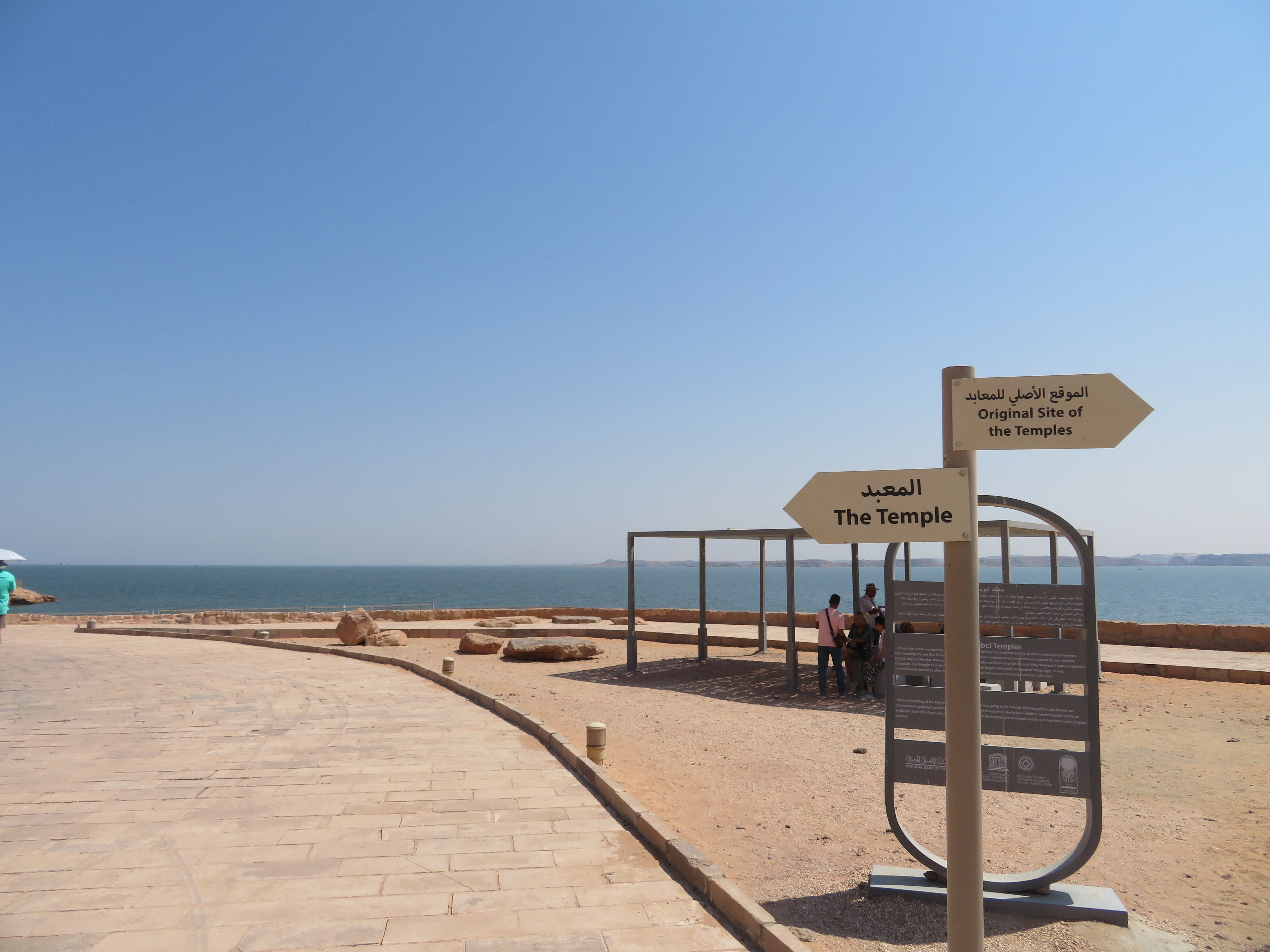
I would be remiss if I don’t touch on the relocation of the temples in the mid-1960’s. Yes, they were moved! The construction of the Aswan High Dam would submerge parts of the original site, so a mind-boggling engineering and archaeological project was undertaken to dismantle, move, and reassemble the temples. The new site is much higher, and further from the river’s edge. The geographic orientation was retained, such that the statues at the back wall are brought to life when the sun penetrates the temple door…just so…twice a year.

 Dirt Roads and High Rises
4 responses to “Ramses II: Power & Love”
I’d forgotten so much of this. Wonderful reminder. The relocation is so amazing. Xxoo
Sent from Yahoo Mail for iPad
LikeLike
Thanks Linda!
LikeLike
A wow. When time allows, please send info how to sign up for this amazing tour. Thx for sharing. Namaste
LikeLike
Sure! It was with AmaWaterways. There are other companies as well, of course, that do Nile cruises.
LikeLike