
After our Cairo easing-in day, we rose early along with the Egyptian haze, the bustling activity of a city with 23 million people coming to life. We piled into our designated bus (there are 61 of us all together, divided into three smaller groups each with a guide), headed for the ancient capital of Memphis. They say to talk about Egypt without touching on Memphis is to talk about Italy without mentioning Rome. It was the capital of a united Egypt (upper and lower coming together), a political feat achieved by King Meni around 3300 BC.
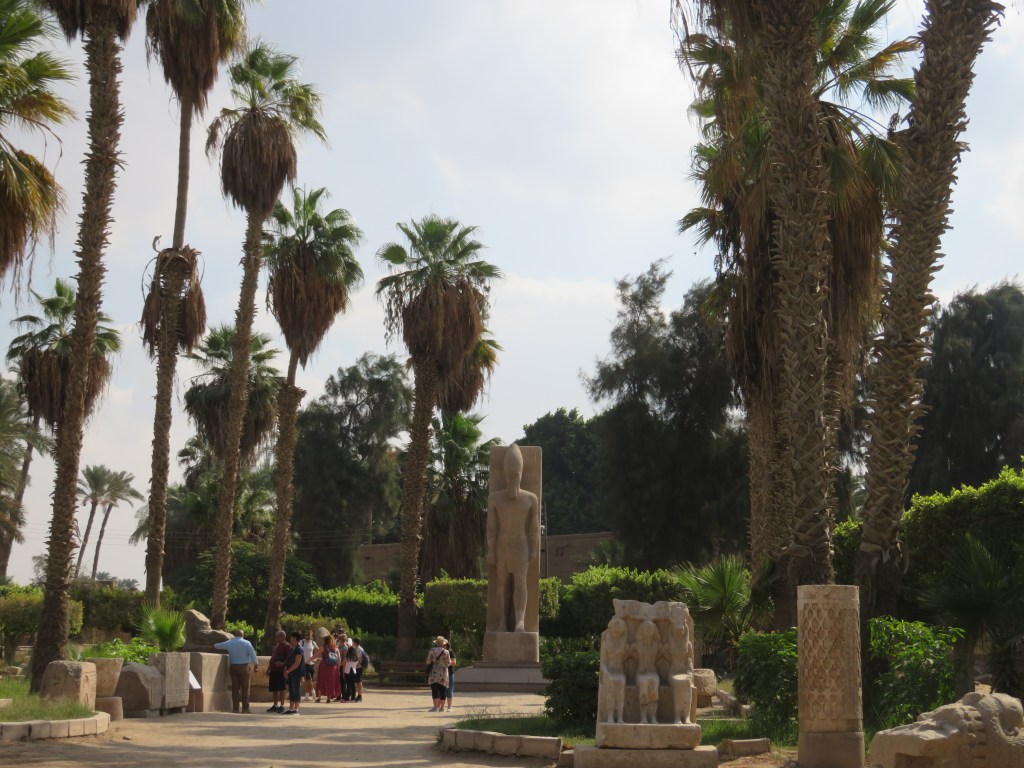

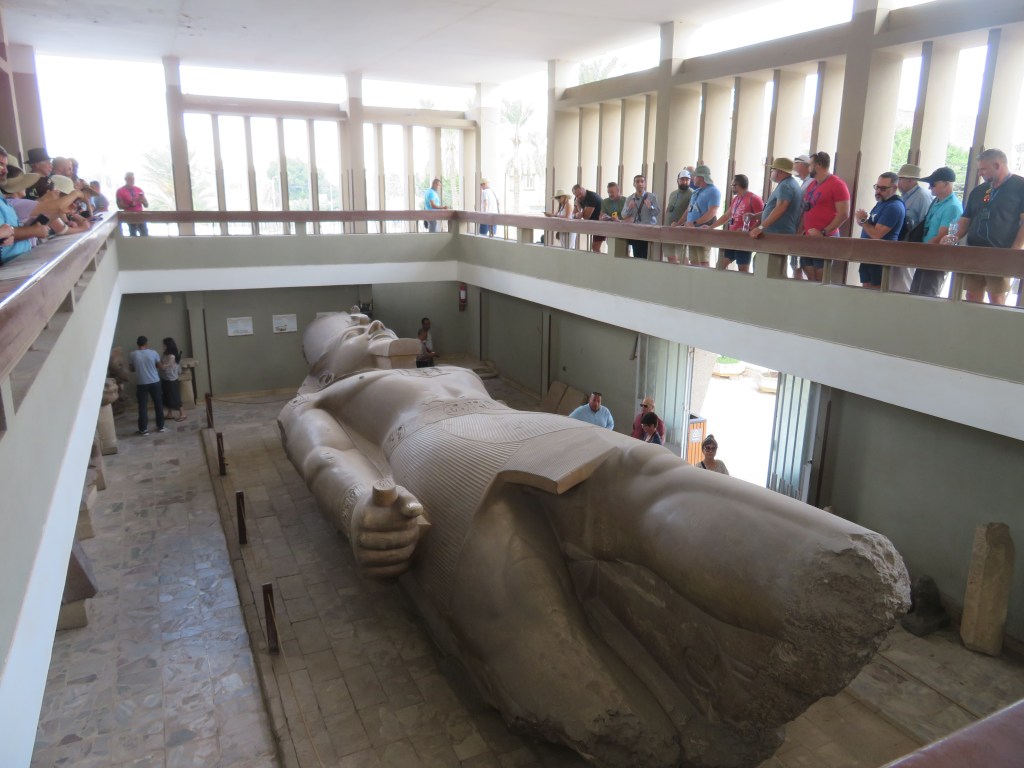
Memphis is an active archaeological site, with perhaps the most impressive find being a massive granite statue of Ramses II (even though he was about 2,000 years later!). It’s fascinating to wander around a place like this, as it seems so random. There are piles of stones, small and large, smooth and ragged, adorned with hieroglyphics, strewn about the site. Maybe they are catalogued, maybe not, and most likely just not yet fitted to a grander scheme of understanding what was once here – and when. Attaching it all to a point in time is nearly impossible given the millennia over which it was occupied.
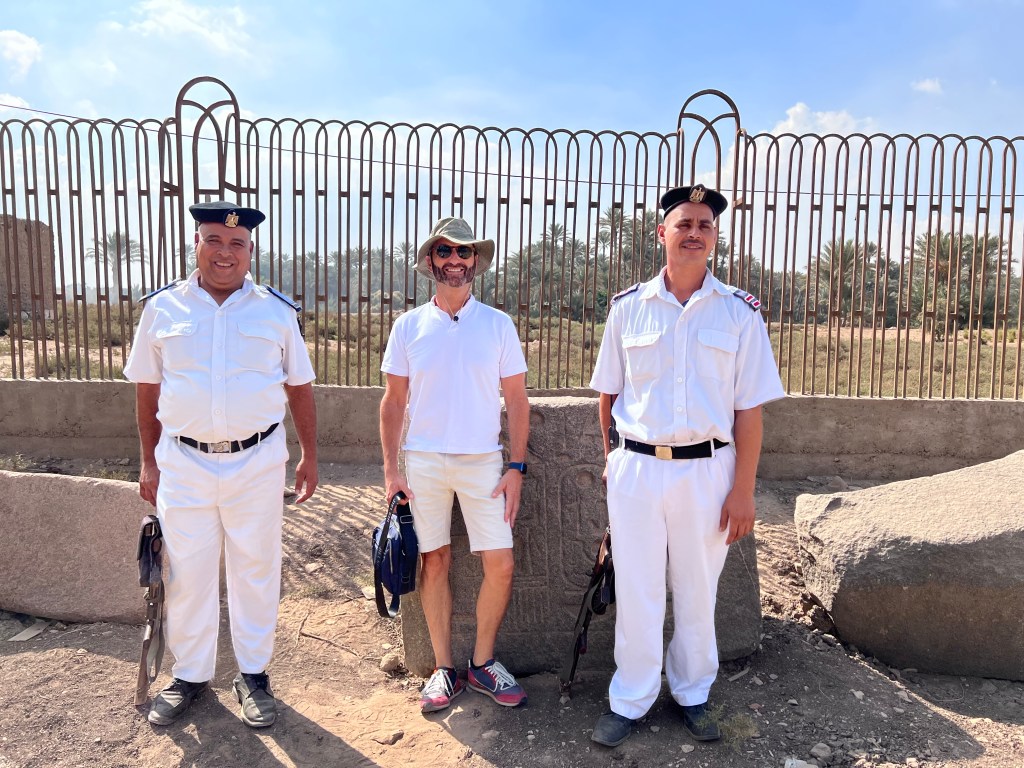
As we wander around the site’s edges, a security guard offers to take a picture with us. Bobb declines but I am all in. We know that everyone expects a tip, but were a bit surprised these guys (government employees) were also in that mindset. They are happy when I oblige and give them a couple dollars. It is a small gesture that puts a smile on their faces.

Making our way back to the bus, the vendors offer up alabaster cats, black and gold painted figures, miniature funereal masks brightly painted in blue and gold, lots of woven and cloth goods…among so many other things. The vendors here are tame compared to what we will encounter later in the trip. Ahmed coached us to haggle aggressively, and I have no problem countering the first offer for a camel-hair weaving at about ½ of what is asked. The vendor’s shock seems genuine, but I know it’s an act…we continue the back and forth…and I leave with a couple beautiful wall hangings.
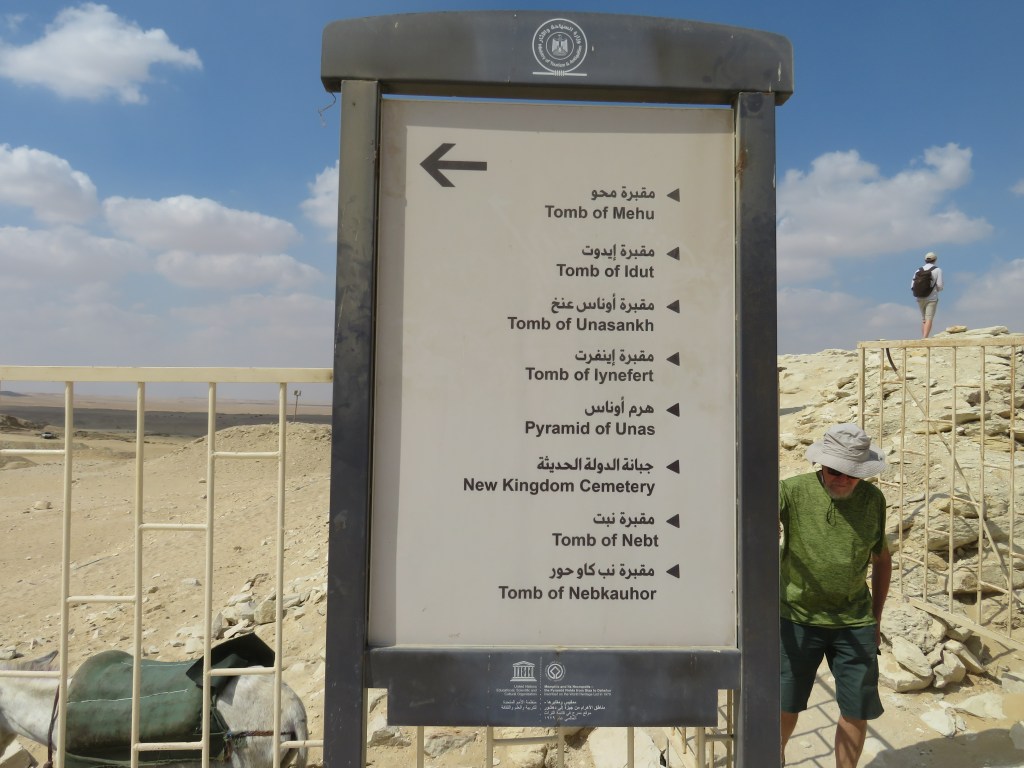
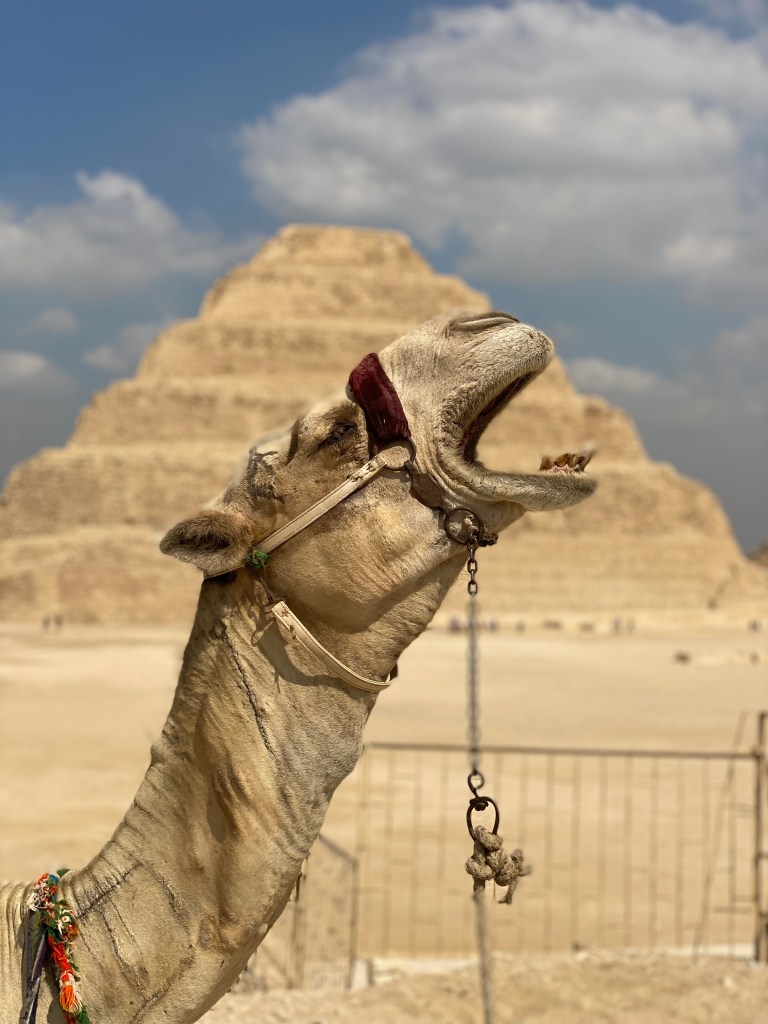
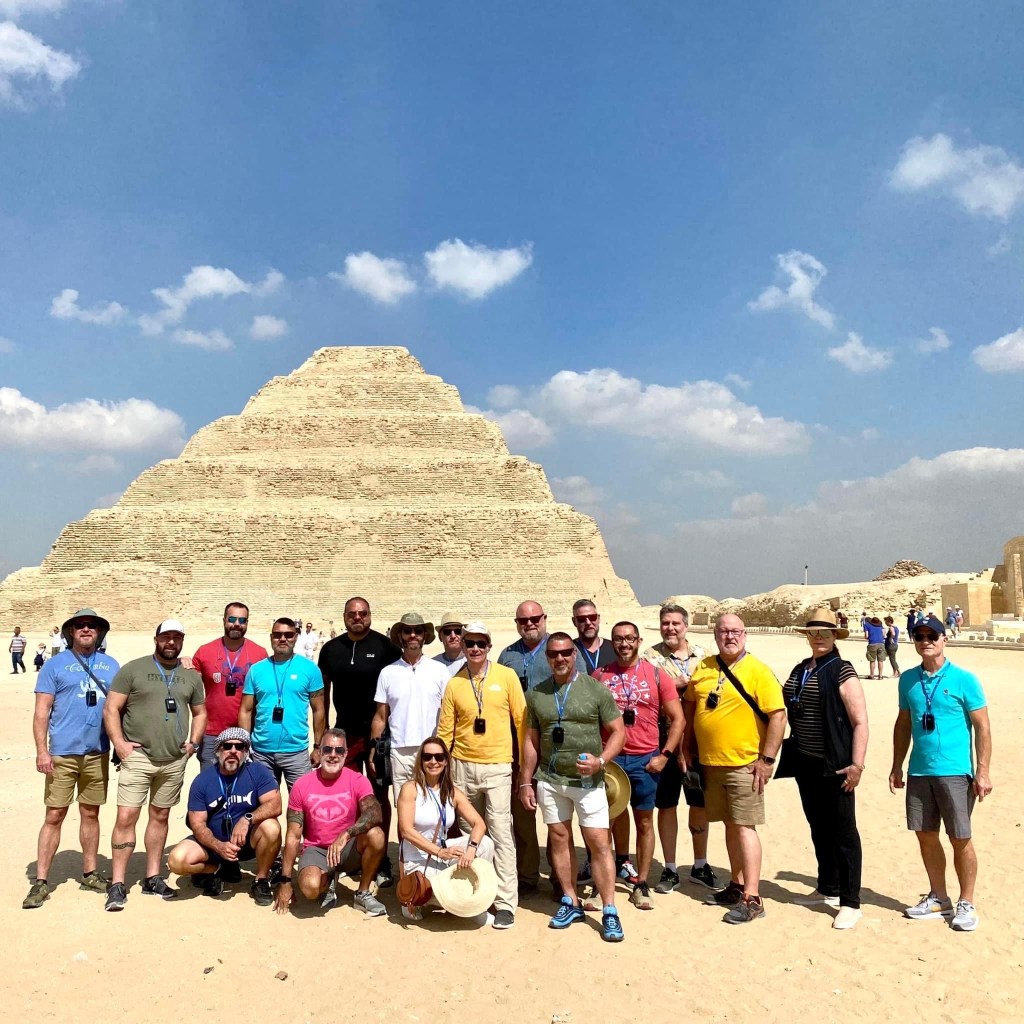
We are building up to the highlights today, so make our way first to Saqqara, known as the “step pyramid” not just for its design but its construction. It’s a massive site of tombs above ground and below, covering an area hard to conceive, going off in so many directions across the dry horizon, a light khaki-colored vista dotted with white rocks and small rolling hills. It is not sandy, although it is very much a desert (rainfall is pretty much non-existent). Ahmed gives us a short talk about Saqqara, and we are left to wander about, gaining a foundation for what will we see in the coming days of tombs and temples.

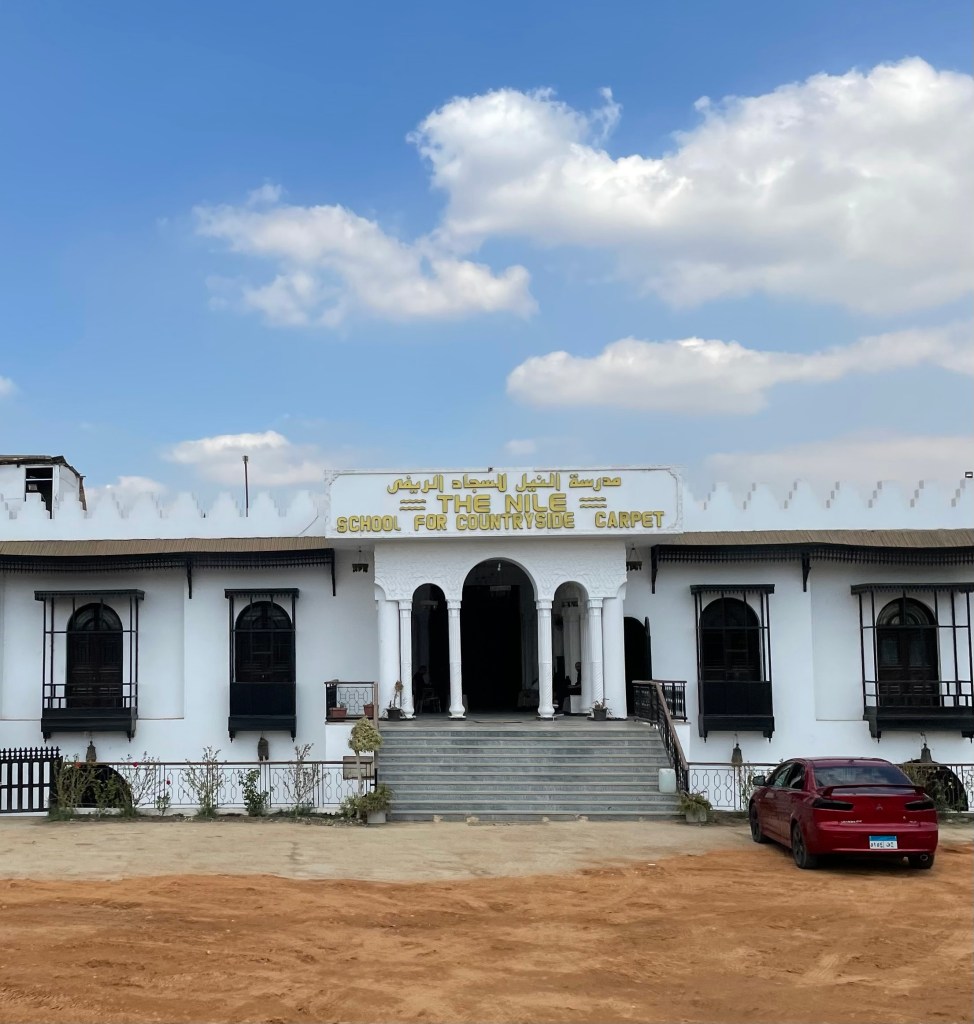
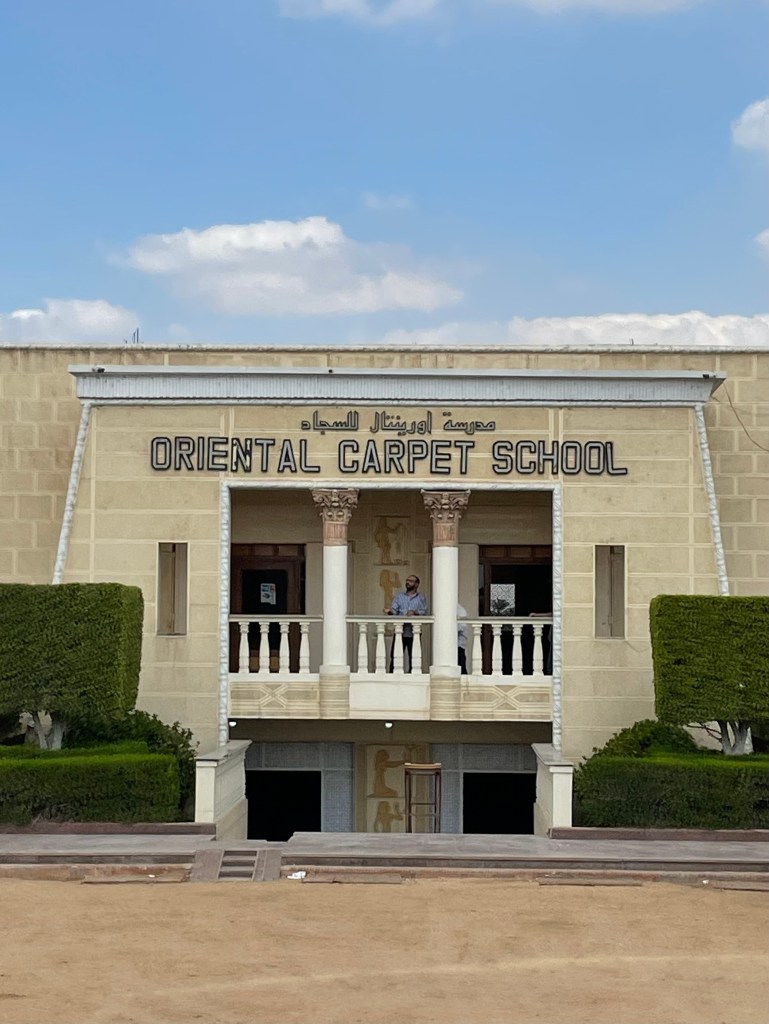
Along the way to Saqqara, we pass what seems a never-ending row of carpet making schools, one after the other. While we mostly think of Persian and Turkish carpet makers, it is big here too. Kids are sent to learn the art of carpet-making, often paying for their tuition by working before and after their classes. Basic skills turn into apprenticeship and later great craftsmanship, providing for a prosperous future.

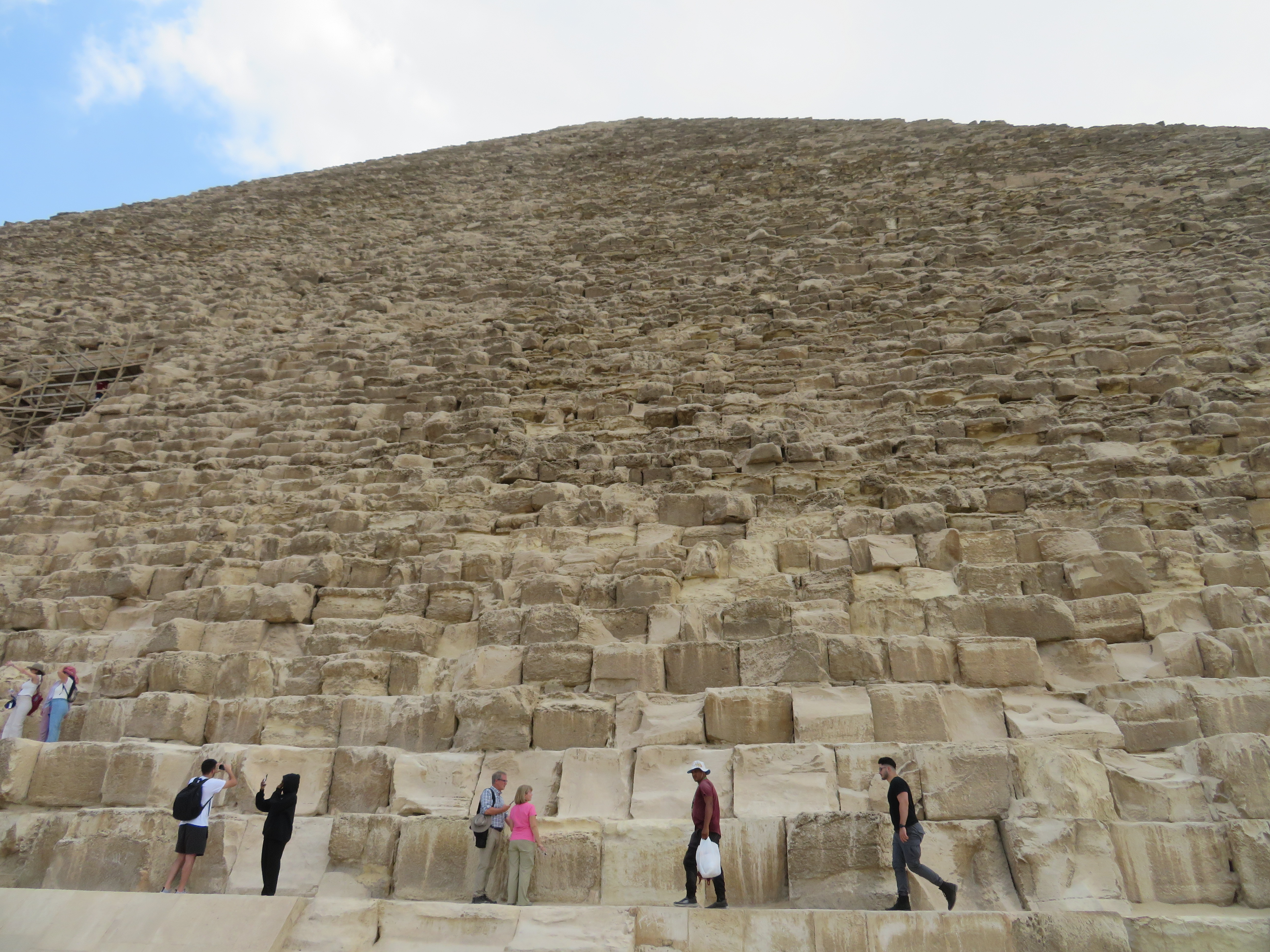
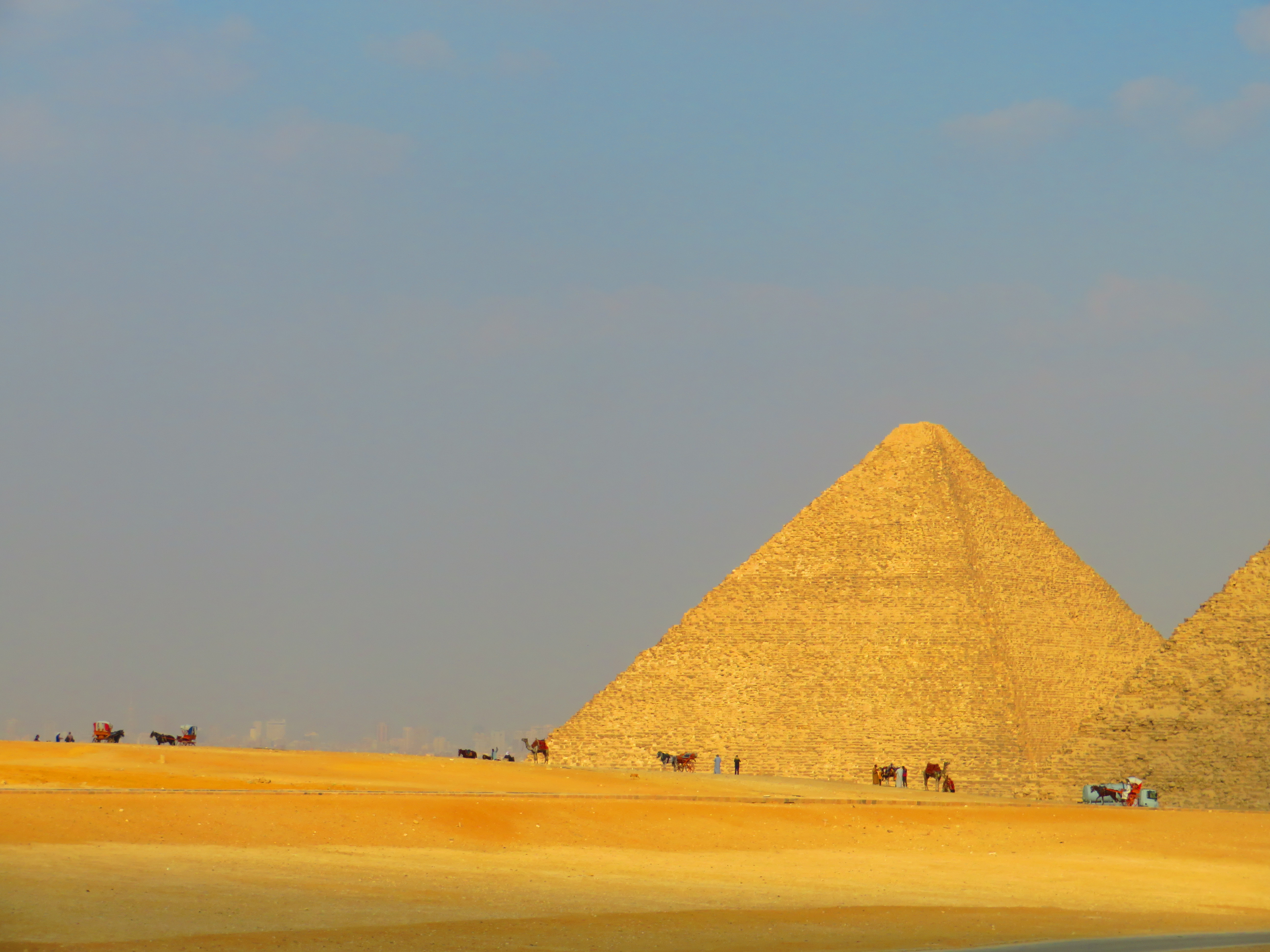
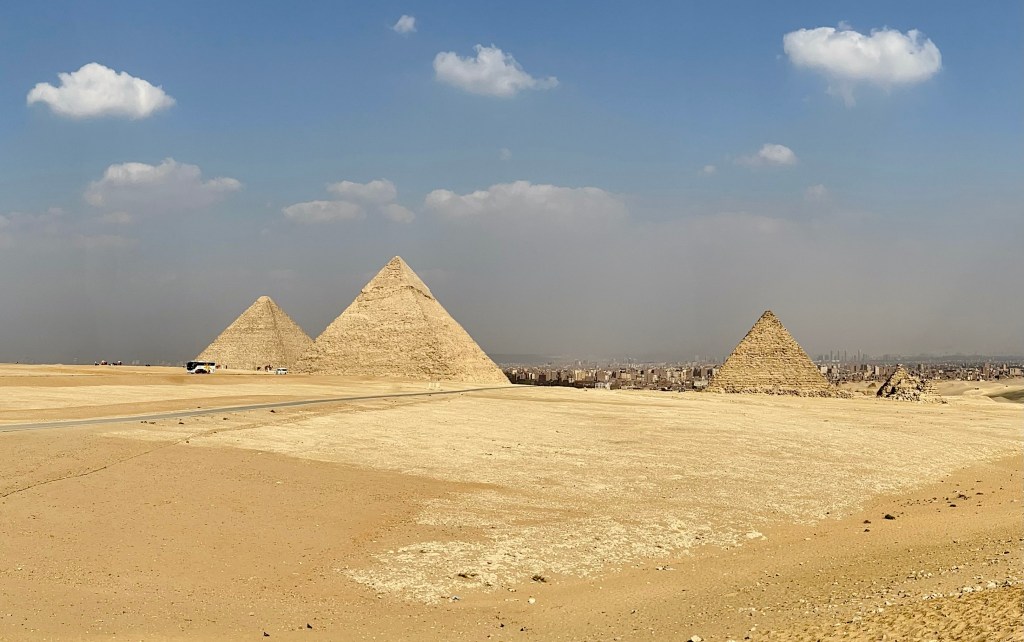
And onto today’s highlight we go: The Pyramids at Giza. From a distance, they appear small and rather simple, and as we approach, they rise higher and higher from the rocky plain. And still higher…the tallest one (The Great Pyramid) is 450 ft high (roughly a 45 story building). It was originally over 480 feet high but the mortar and “cap” that made it taller is gone. There are many, many tourists shuffling their way to the entrance gate, quickly showing tickets and stopping in awe as soon as they get through. It is an astonishing sight. Ahmed is telling us about the three pyramids but it’s hard to concentrate on what he is saying when this towering spectacle stands before us. It is so imposing, climbing steeply into the blue sky, it’s just impossible not to be overwhelmed. And to think that they were built 3,600 years ago is mind boggling. Assembled stone-by-stone, and each stone is HUGE – solid blocks of limestone – 3-5 foot not-uniform cubes, each weighing tons, fit together with incredible accuracy and engineering. How the pyramids were built – and by what laborers – remains a topic of discussion to this day (it was not Jewish slaves. Sorry Hollywood!).
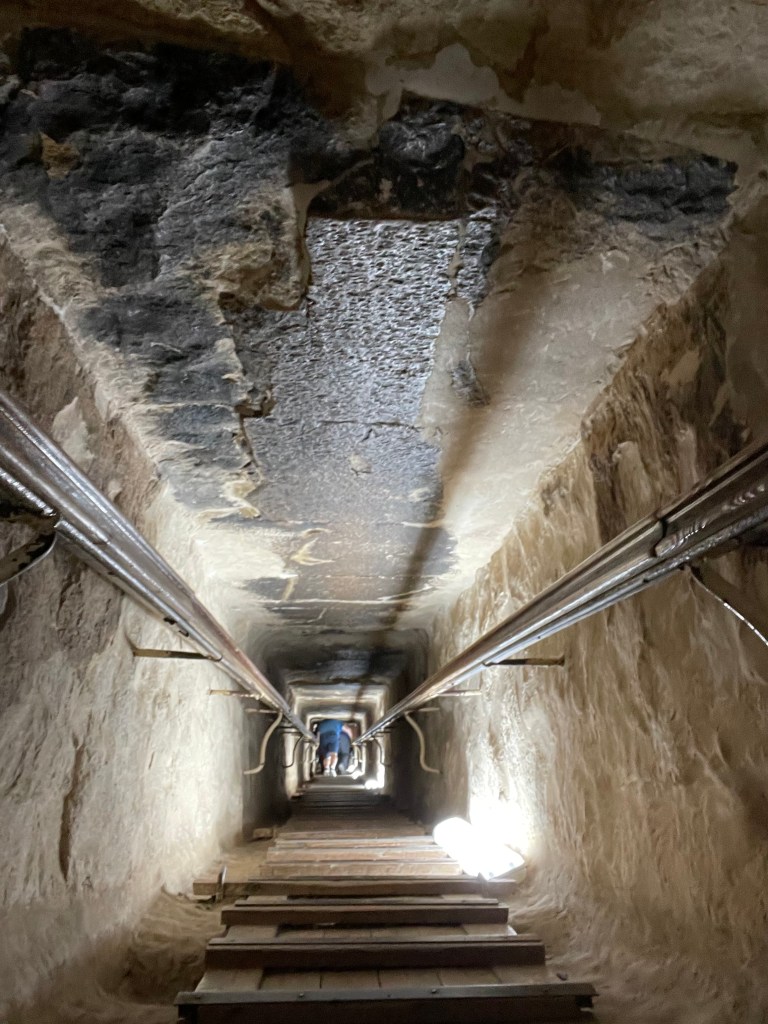
A few of us have opted for the special ticket to go inside the pyramid and up to the king’s burial chamber. Anticipating a narrow, crouched tunnel, we are surprised that it is sort of like walking into a large cave. Its craggy walls lead us further in, but we are standing and the air is clear, the light bouncing off the grey stone, illuminating our path. And then we turn a corner to a step/ladder that puts us at the bottom of a narrow tunnel ascending steeply to a mysterious destination. We wait for others to come down, then realize this is a two-way street and keep going, wrangling and twisting past each other, those going up watching the sweat drip off those coming down. The air gets thicker and hotter and humid. The climb is steep, challenging even the most fit among us. A landing of sorts is at the top, and then again, another climb in the air that is now palpably heavy and wet. We keep going, finally through a very low section that requires crawling until we emerge into the burial chamber. It is a rather large square room, its only contents a large granite coffin. We figure we are about ½ way up inside the pyramid. It’s too hot and humid to spend much time here and I am sweating…along with everyone else…as we snap some pictures (it’s starkly lit with a couple fluorescent tubes) and anticipate the “climb” back down the steep tunnel.

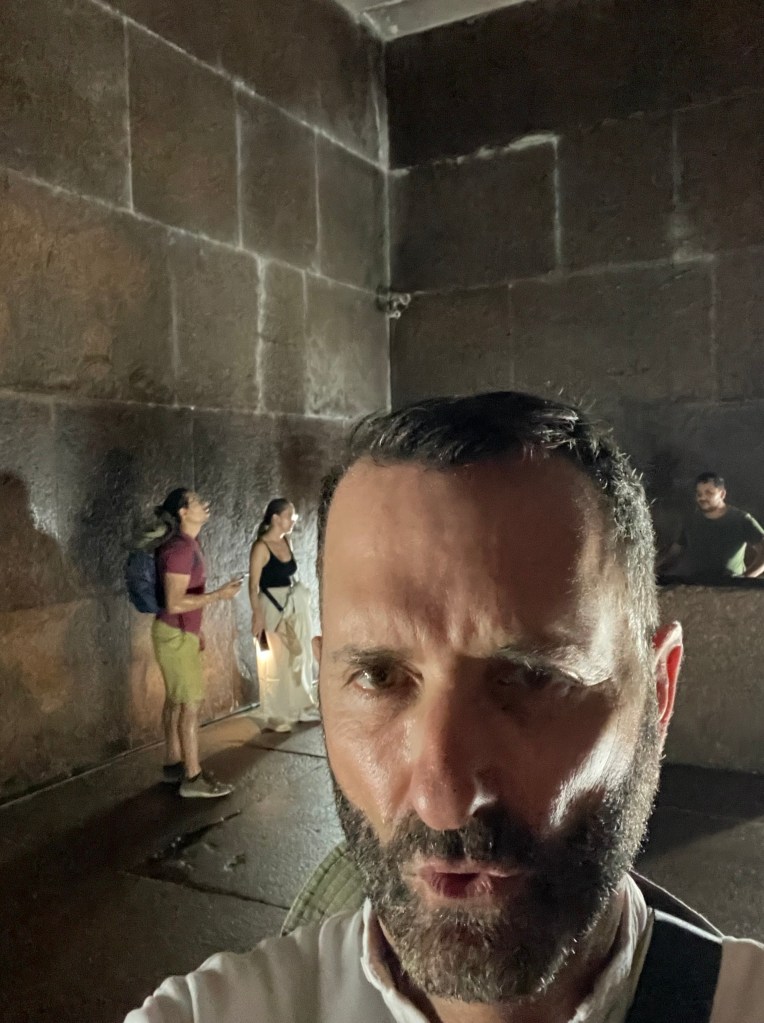

The sunlight blasts as we come back out, but the air is cooler and cleaner in comparison, a welcome relief. Seeing the pyramid from the inside it is evident how precise the stonework is. Each block fits the next perfectly with no mortar, the seam maybe an 1/8”. Remembering this was done thousands of years ago without modern tools and techniques is just…. 😲
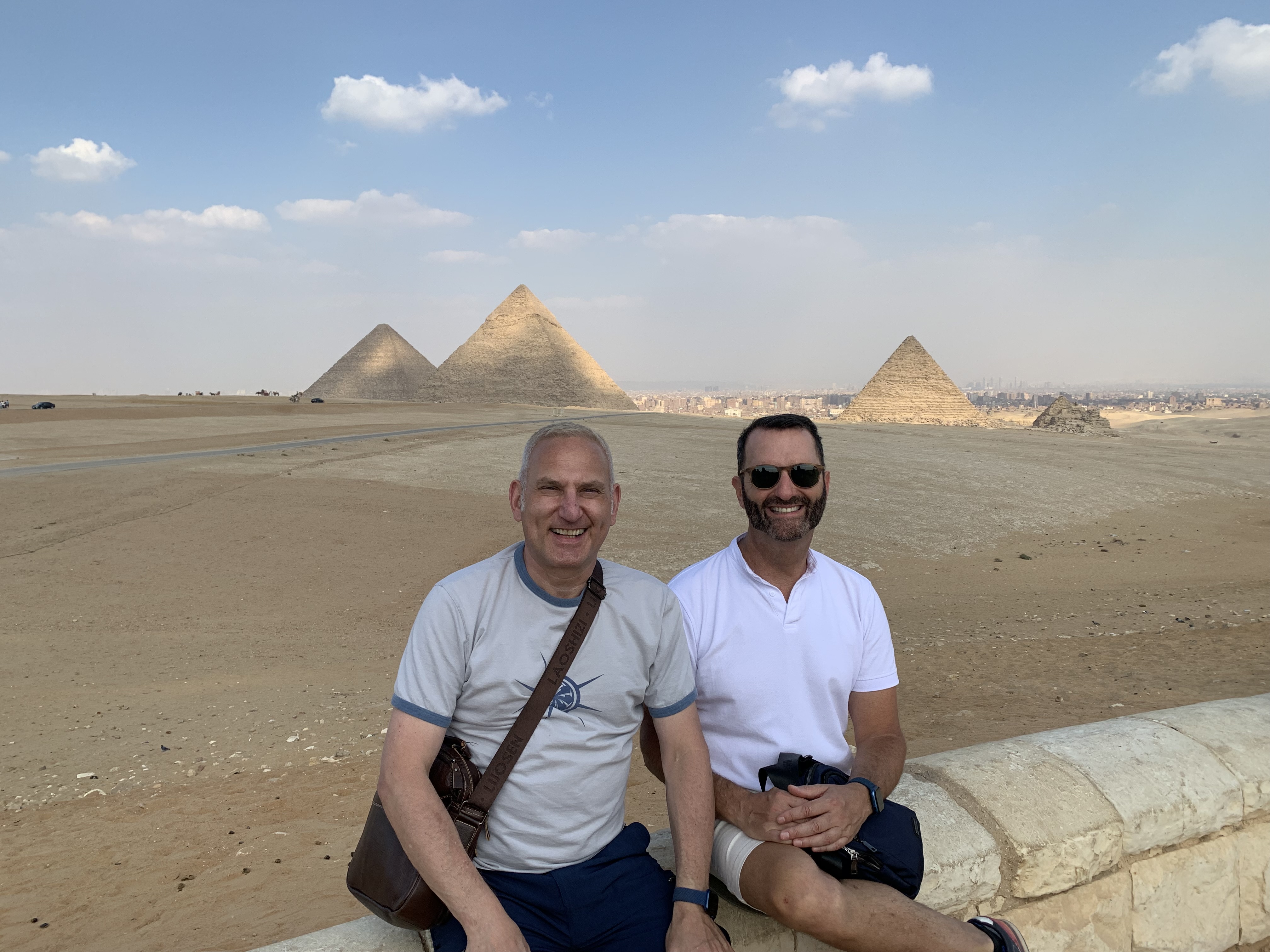
After once again navigating the parade of guys hawking mementos (yes, it’s all men), we drove to a higher vantage point that gave us all three pyramids. Some took camel rides while others of us just took in the panoramic view of antiquity against the backdrop of modern Cairo. The Great Pyramid is only a few meters taller than its son – built by the prince who had to make his shorter than dad’s. It didn’t mean he couldn’t put it on a higher plain, and thus from many perspectives, it appears taller. He is also believed to have died before it was complete, hence the partial smooth covering at the top; a king must be interred within 70 days after death.
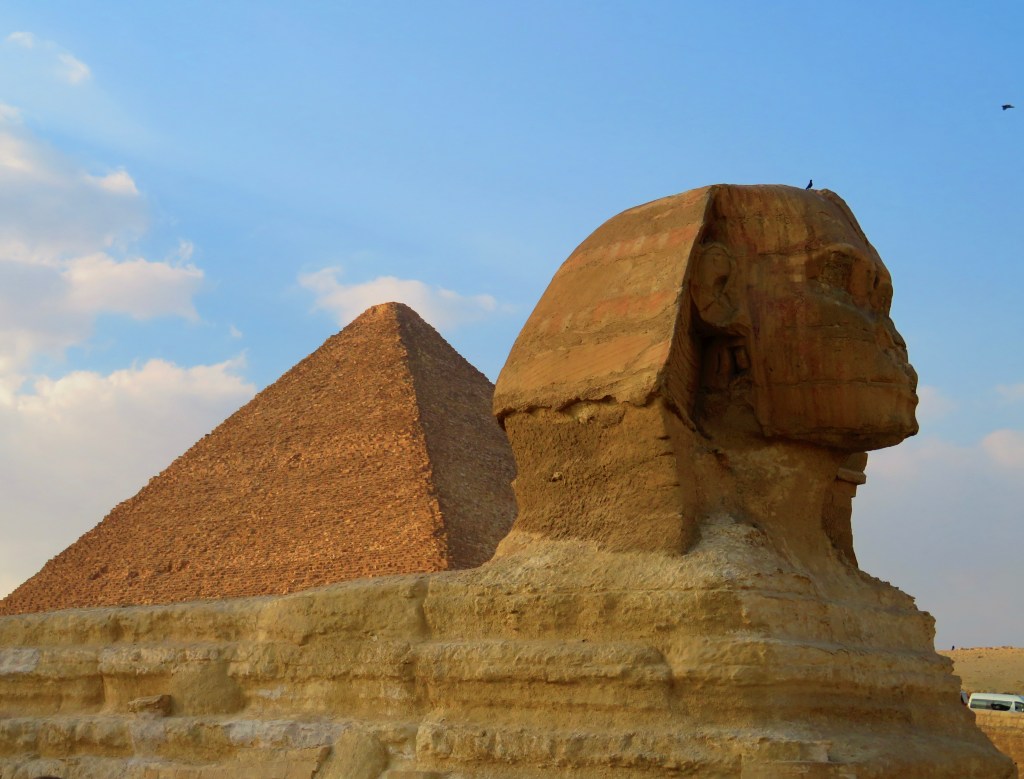
Just over the hill from this is the mythical Giant Sphinx. It is the head of a human (likely the Pharoah Khafre) on the body of a lion. Ahmed tried to temper our expectations; it is not as imposing as you might think, according to him, and while the largest, it is but one of 1,000s of sphinx statues known from ancient Egypt. I’m not sure I agree with Ahmed. The Great Sphinx is just breathtaking, especially if you squint and imagine it before the erosion and damage caused by the human pillaging and unforgiving desert sands over thousands of years. It was discovered mostly buried, it’s head just above the rolling dunes. Although the visage is weathered, it seems to know, through its crumbling façade, that it is powerful and impressive and to be revered.
The Sphinx rests on his haunches, purring among The Pyramids, somehow giving life to the desolate and treeless landscape, ensuring we remember the centuries that have passed. And it makes us wonder about the centuries ahead, the treasures we are building today, and whether they will survive as he did…
 Dirt Roads and High Rises
3 responses to “Pyramids and the Body of a Lion”
Thanks.
Hal Glassberg Sent from my iPad
>
LikeLike
A cabin crew saying hi from Taiwan !!
ps: I love your photos!!!!
LikeLike
and hello from California!
LikeLike