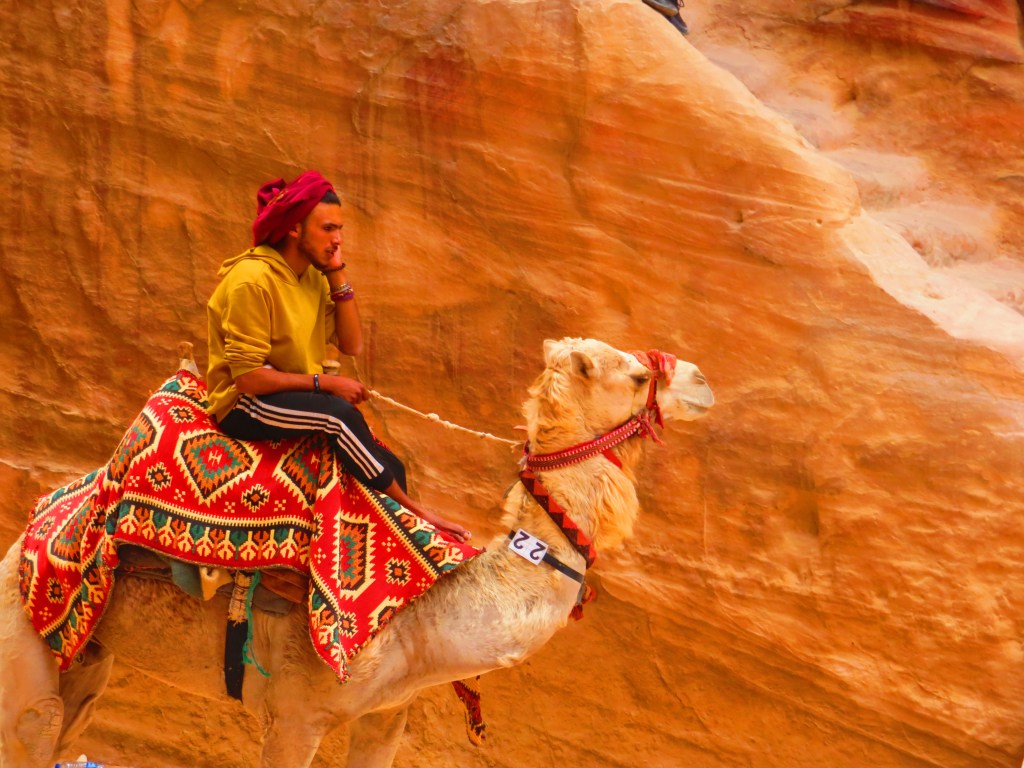
Petra.
On every world-traveler’s must-see list, and rightfully so.
One of the seven wonders of the modern world*. It earns that spot with ease. It is truly astonishing. But I jump ahead in this desert tale…
We set off in the early morning through the dry and rocky landscape, the vistas a bit more populated than we had seen up to this point. A small town here and there, a village blanketing a hillside, often of two- or three-story homes, as Jordanian tradition has the sons and their families living upstairs from the parents. Construction is left unfinished at the roof so another story can be added when the time comes.
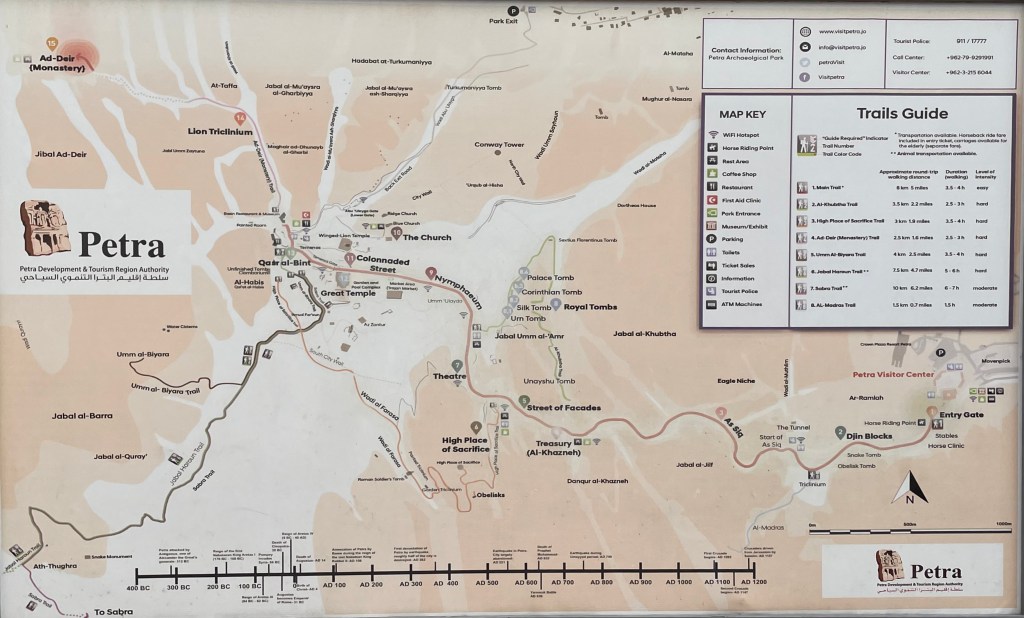
A three hour drive from the Dead Sea landed us at the entrance to Petra. Not so much an entrance as a dusty, pebbly dirt road winding slowly downhill to an unseen destination, one that foretold of the steps taken here for thousands of years. We really didn’t know how long this road was (the “center” of Petra not being visible from here), and that bit of mystery gave us a sense of exploration and discovery we didn’t quite expect.
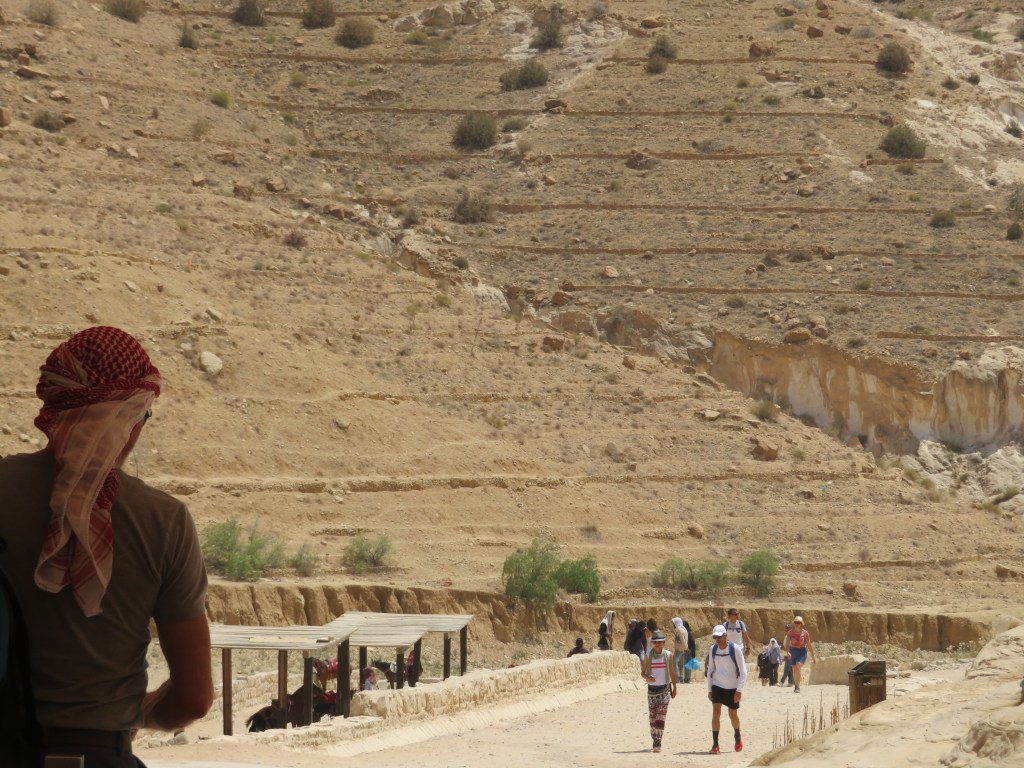
The main road is called The Siq, and as we ventured down, our guide Fadi emphatically warned us about the tourist element we would encounter. “If you want to take a horse down to the central area, you can do so, but expect to tip generously. It is not free even though they will tell you that it is. And later you will be offered camel rides, and there will be merchants selling souvenirs and jewelry and spices and incense and such. If you want to buy something, I encourage you to bargain with them; they expect it. Do not say “maybe” or “I’ll come back” as they will take that as a promise. Say no if you mean it, and move on.” This proved to be good advice.
Before this story continues, a short bit of history provides some context for a visit to Petra. Over 2,000 years ago, in the 1st century AD, the Nabataean Arabs carved the city into the mountains. The location was strategically at the junction of trade routes that linked China, India, and Southern Arabia with Egypt, Syria, Greece, and Rome. Controlling trade routes is always valuable, even today. It was also geographically ideal to be surrounded by mountains that protected the community and provided a built-in defense for the city.

Jumping to more modern tidbits, Petra was “discovered” in the early 19th century by a 27-yr old Swiss traveler, although the locals always knew it was there. In 1985, it was declared a UNESCO World Heritage site, and until very recently, people continued to live in Petra (in the caves and/or bedouin tents). In order to support tourism (a major contributor to the economy), the Jordanian government relocated the inhabitants in exchange for concession rights.
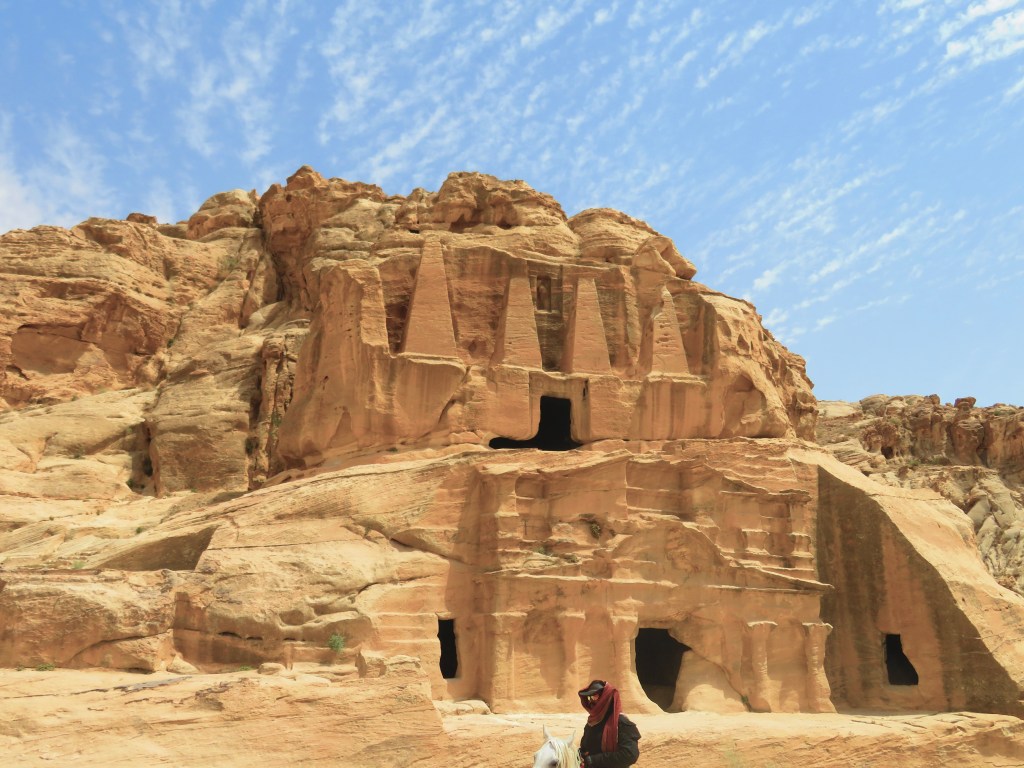
The rose-colored mountains are spectacular in and of themselves. They slowly grow taller as we descend the gentle slope, at times closing in on us as if granting permission to enter…a permission they could easily take away, engulfing us in their sandstone grip. The mountains kept growing as we felt smaller, and reached hundreds of feet into the blue sky by the time we reached a stopping point. Fadi cleverly created some drama for us as we unknowingly came closer to the iconic image of Petra, The Treasury, having us walk single file on the right hand side, and then stop. We wondered what was going on. He waited for other visitors to clear, and then “step to this side now,” revealing our first glimpse of this magnificent, ancient creation.

And as we went forth, it just became even more astonishing. It’s massive for one thing – nearly 150 ft high and 90 feet wide. And it is carved – carved! – into the mountain. If you look closely in the picture to the left and right you will see notches in the hillside. Those were their scaffolding – they started at the top, notching one step and then another…as they continued the carving from the top down to the valley floor. They then hollowed out the inside, as this and the other carvings throughout Petra are tombs. The hillside caves in which people lived had no elaborate decorations.
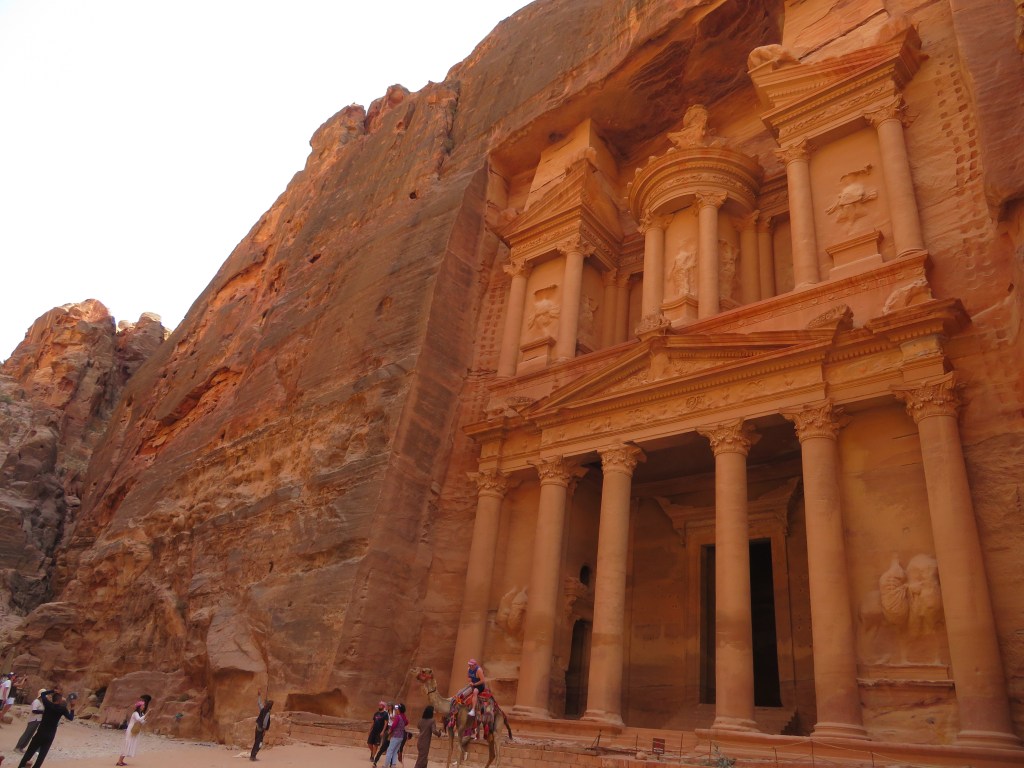
We stood in awe, staring up at this amazing creation, listening to Fadi tell us more of its history (while simultaneously refusing the camel rides that were indeed offered as he said they would be). An interesting tidbit: it’s called The Treasury because it was once believed to hold the riches of the city behind its central figure, and bandits shot up the façade hoping it would fall and reveal its contents. To their dismay, sold rock was all they hit, but the legend gave this wonder its moniker that lives on to this day.
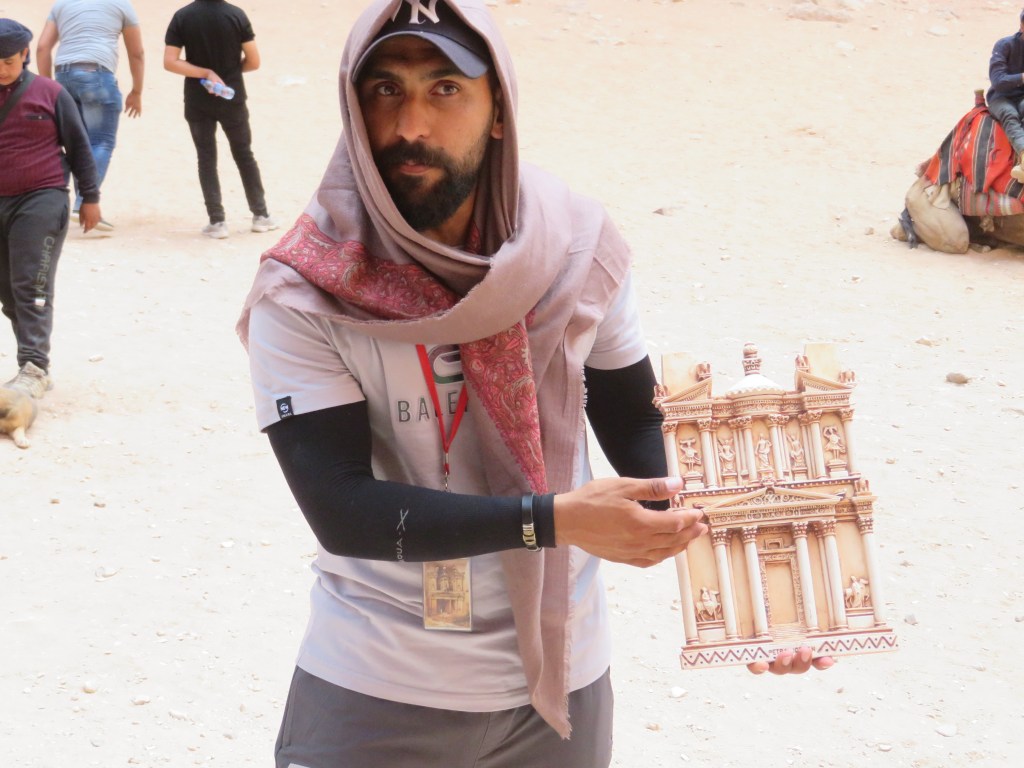
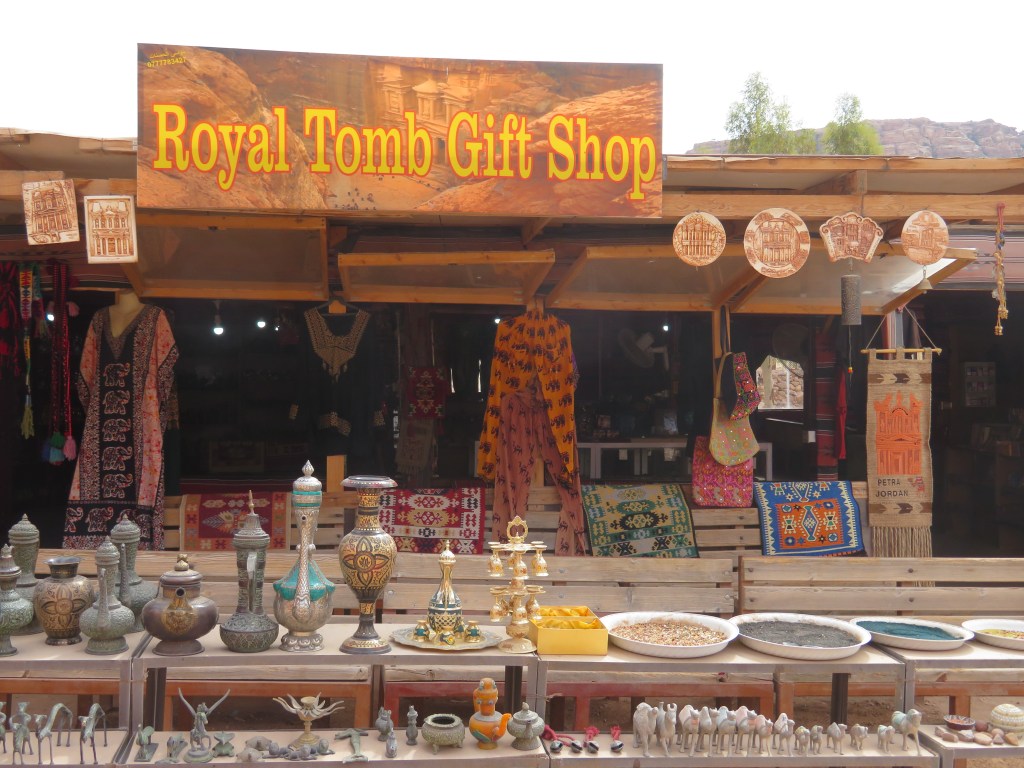
And we journeyed on down the road, our shoes getting dustier and our interest in the merchants fading with each passing table, until we gazed upon more and more of this ancient civilization. A theater carved into the red stone, and tomb after towering tomb upon the hillside, interspersed with caves where the wealthy citizens lived (others lived in houses made of stone, long since collapsed into piles of rock).
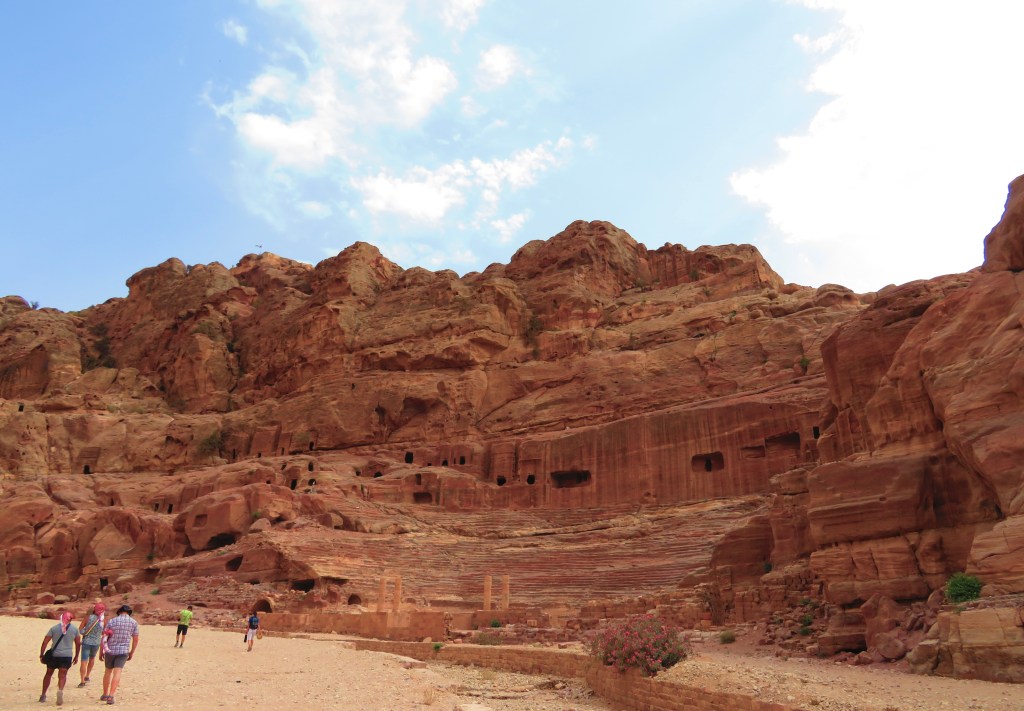
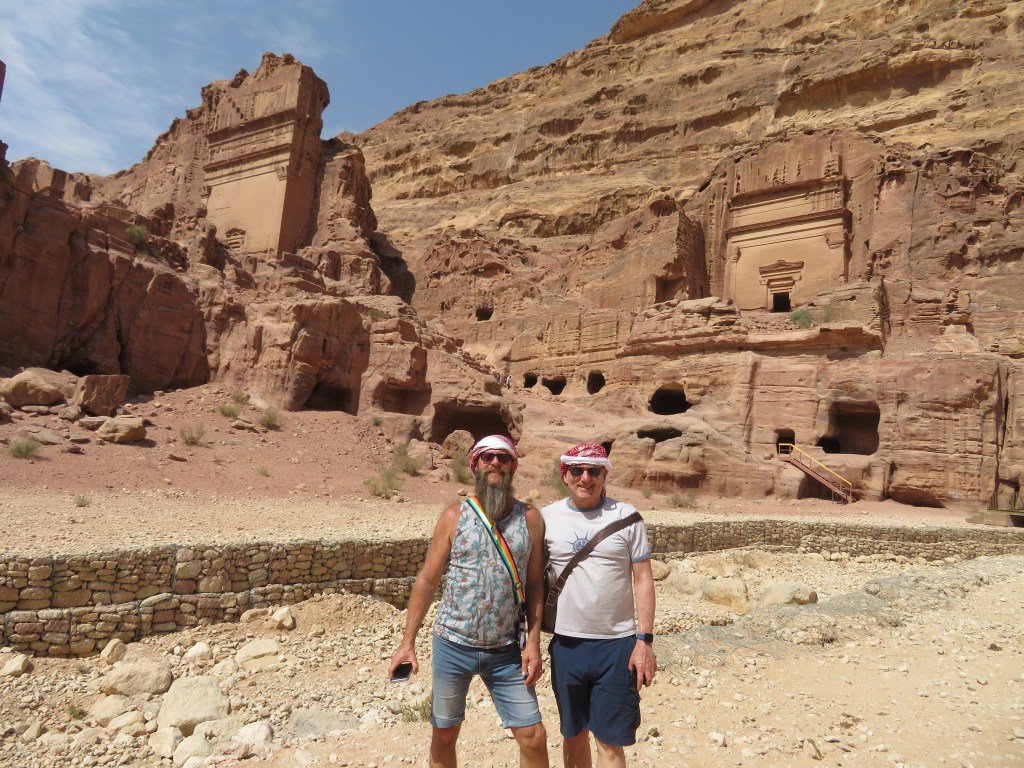
Looking back to where we started and how much road remained in front of us, it hit us that therein lies just one of Petra’s surprises – it’s huge! I will admit to my naïveté, having really only seen pictures of The Treasury, and while I presumed there was more to it than just that, I had no idea it was once a thriving city of 40,000. And interestingly, a culture very much alive amongst its dead. That sounds strange, for sure, but dotted along the entire main road and surrounding the city center were tombs. Some massive and imposing, ornately carved, others barely adorned, but each one an ever-present reminder of those who came before. And the homes for the living all nestled among them.

As we stood in the center of Petra, in awe and unbounded wonder, all around us the carved cliffs and caves told tales of a people and their daily lives that we could hardly imagine. What would life have been like here so many years ago? If we picture children playing…tending the animals…parents making meals…vibrant trade…visitors from near and far…being entertained by players in a massive theater…then, perhaps in many ways, the people who lived here were really not so different than those of us wandering the ruins today.
*The others are: The Great Wall of China; Christ the Redeemer (Brazil); The Taj Mahal (India); Chichén Itzá (Mexico); Macchu Picchu (Peru); Colosseum (Italy).
Bonus story! This didn’t really fit the narrative above…
Brian and I get sidetracked by shiny things, so on the way back up the main road we stopped to admire some small cast-metal camels that are decorated with what is likely glass (supposedly semi-precious stones). When asked how much, the boy selling them said “120 each.” That’s 120 Jordanian dinar, roughly US$170. You’ve got to be kidding! We politely declined. He then said since we were with Fadi, who is a local and he knew him, we could have both for 120 JOD. We still said no, and walked on. He followed us, and with each step, the price went down…100…80…75…70…60…55. Each time we refused, and while we were tempted at 50, we still declined firmly.
We then had to catch up with our group, who were getting the golf carts to take us back up to the entrance (you can walk but it’s rather far and uphill and it’s HOT). In the hustle and bustle, I lost Brian but then joined him in one of the carts. He had the little camels. He paid 20 JOD for both…
We were happy with our souvenirs, a good story, and the boy got a sale. And just so you don’t think we totally swindled him, we later saw the same camels at a big tourist rest-stop for 12 JOD each…
 Dirt Roads and High Rises