
Visiting a place of biblical history cannot help but move you. It connects you to a past time and place in a way that the teachings of theologians and history professors simply cannot. And in Jerusalem, the intersection of faiths and cultures is palpable…you can feel it in the air, see it on the faces of people walking the ancient stone-paved streets, in the doorways of synagogues, churches, and mosques, and even sense it among the twisted trunks of ancient olive trees that dot the landscape. It is in the food and the music and the clothing and the chatter of the adults and the laughter of the children…
The Old City of Jerusalem is rather small, and still surrounded by a very high wall with just seven gates to enter. One of the gates was closed by the Ottoman Sultan Suleiman – it is the Golden Gate, through which Jesus entered the city on Palm Sunday. There are many theories as to why it was walled off (originally in the 9th century, then opened, then again closed in the 16th century). Many believe it was done to prevent the Messiah (the Jew’s Messiah, not Jesus) from entering the city from the Mount of Olives. It is closed to this day.

Inside the Old City is a vibrant, diverse community – the Jewish Quarter, the Muslim Quarter, the Armenian Quarter, and the Christian Quarter. The Muslim Quarter is the largest, especially if you include the Temple Mount. The bit above about Jesus is perhaps a bit misleading as an introduction, as the Old City is as equally a story of the Jews, the Christians, and the Muslims. Understanding this intersection is key to appreciating the millennia over which conflict has existed in this region, something I just didn’t really get before coming here.
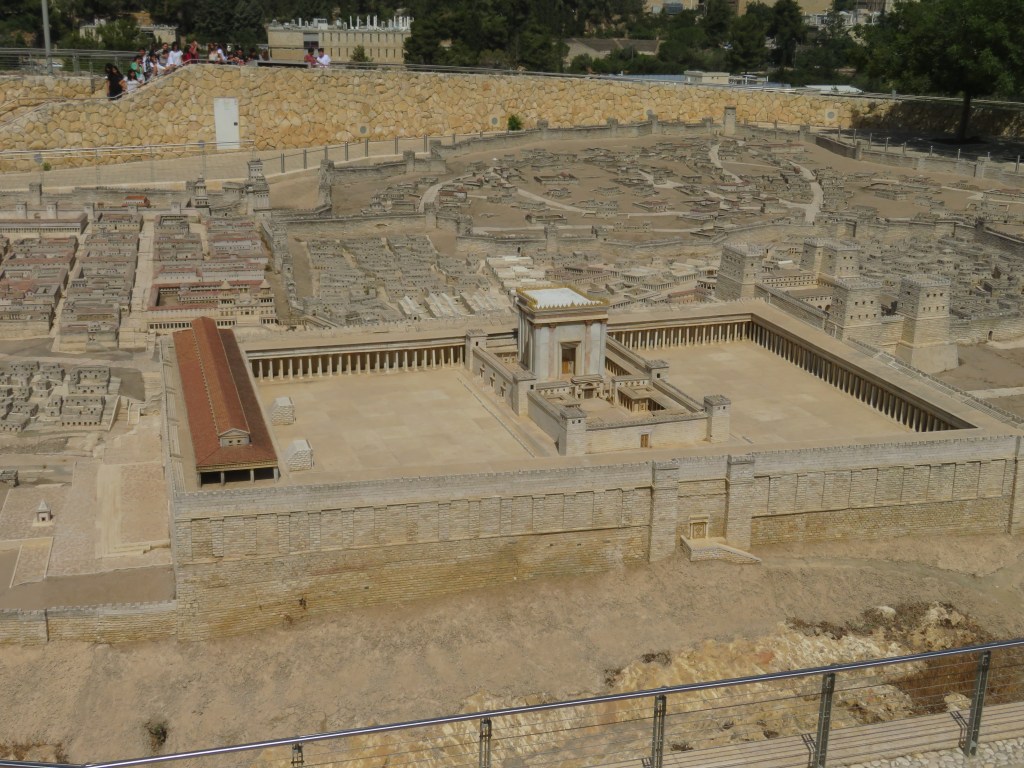
So some high level bits (with apologies for details I am sure I have wrong): this land has been occupied by Jews for thousands of years, or at least versions of what we know as Jews – tribes of Israelites that went by many names. It is the location of the “binding of Isaac,” Abraham’s willing sacrifice of Isaac to God, which turned out to be a test of his faith averted by the appearance of an Angel at the last minute. God then promised this land to the Jews, and they built the First (10th century BC) and Second Temple (6th century BC) here – a house of God in which he dwelled (in Judaism, God has no form; it is only his presence).
At the same location – the rock underneath what was the First and Second Temples – is where Mohammed the prophet rose to the heavens, thus the importance of this place to Muslims. Jerusalem is the 3rd most significant Muslim site, after Mecca and Medina.

And of course this is were Jesus spent his final days – convicted by Pontius Pilate to be crucified, he carried the cross (sometimes assisted with that effort, they say) to the place where it was raised (now a church), where he died, and his body prepared for burial, was interred at the Church of the Holy Sepulchre (a “cave” believed to actually be one of the crypts below the church), only to be found missing three days later. He is said to have appeared to the apostles for 40 days before rising to the heavens from the Mount of Olives (the location also a church now). His journey from conviction to resurrection is called the Way of the Cross, which we walked the entirety of (it is a relatively short distance, frankly). This is marked by what we know as the 14 stations of the cross.
All of these locations – Jewish, Muslim, Christian – are now crowded with deeply religious and devout believers as well as curious tourists and everyone in between, each seeking some connection to faith or history or both. It is in this intersection of time and space that we can appreciate why Jerusalem is the center of the universe for billions of people.

I would be remiss in talking about the Old City if I didn’t share a bit about the Western Wall. I will admit to my naïveté before visiting here – what exactly is it and why is it so important to the Jews? The architecture is where to start…
The Second Temple (into which only the Jewish high priests were allowed) was built on top of the Temple Mount. The Temple Mount is essentially a giant elevated platform. It is massive – the wall is about 60 feet high. The entirety of the Western Wall is over ¼ mile long; the part famous for visiting is rather short in comparison.
When the Second Temple was destroyed, it was thought that it would drive the Jews away from worshiping there, but since God has no form to the Jews, they believed he still existed at the site and would come to pray there. It did not matter that all that was left were the walls of the Temple Mount. It is amazing that a couple thousand years later, that continues. Today, the Temple Mount is topped by the Dome of the Rock “al Aqsa” mosque, built in the 7th century CE. Jews are not permitted, nor is anyone who is not Muslim.


And with that butchered history lesson which omits centuries of detail, we sit in modern times looking back at all this as if it has happened in a time span we can imagine. It is impossible to really do so, and yet, we try. To think of the Jews worshipping here for 4,000 years…to a time of Judas’ kiss in the Garden of Gethsemane…through to Muslim conquest and the construction of the mosque…which itself has now been there for 1,400 years. It is truly an inconceivable amount of time, and still, it provides a perspective that the time in which we exist is but a fragment.

And in that fragment, we come here to feel the presence of a higher power, to pray in whatever way that is meaningful to us, to experience a living history, and even to lead the children of our age in song and dance.

We are here for but a moment.
Shalom.
 Dirt Roads and High Rises
One response to “The Old City Where Faiths Collide”
[…] If you’re interested, there is more on the Old City in a post from June 2022: The Old City Where Faiths Collide […]
LikeLike